In the sprawling landscape of Chinese retail, few stories are as compelling (or as instructive) as that of Pangdonglai. Despite its low global profile, this fourth-tier city supermarket chain has quietly rewritten the rules of profitability, employee engagement, and customer loyalty, outperforming national giants and drawing the attention of international retailers grappling with the notorious “localisation failure” in China. For international brands entering China, understanding the Pangdonglai secrets to success gives insights into how multifaceted the country is with no single guaranteed route to selling successfully in China.
One of the biggest mistakes I see is brands assuming that China is a single, homogenous opportunity that rewards speed and capital above all else. Pangdonglai challenges that assumption directly. Its model forces us to ask whether depth, trust and operational precision might outperform expansion and brand noise.
With just 13 stores, Pangdonglai has demonstrated that scale is not everything and that human-centric strategy, extreme service, and digital efficiency can yield extraordinary results. The Pangdonglai winning strategies demonstrate that emotional profitability, operational rigour, and community integration can outperform sheer capital investment under certain circumstances. In my work advising international brands on China market entry, Pangdonglai comes up again and again as an uncomfortable counter-example to how most foreign retailers think about scale….
Table of Contents
Outperforming the Giants in the Metrics That Matter
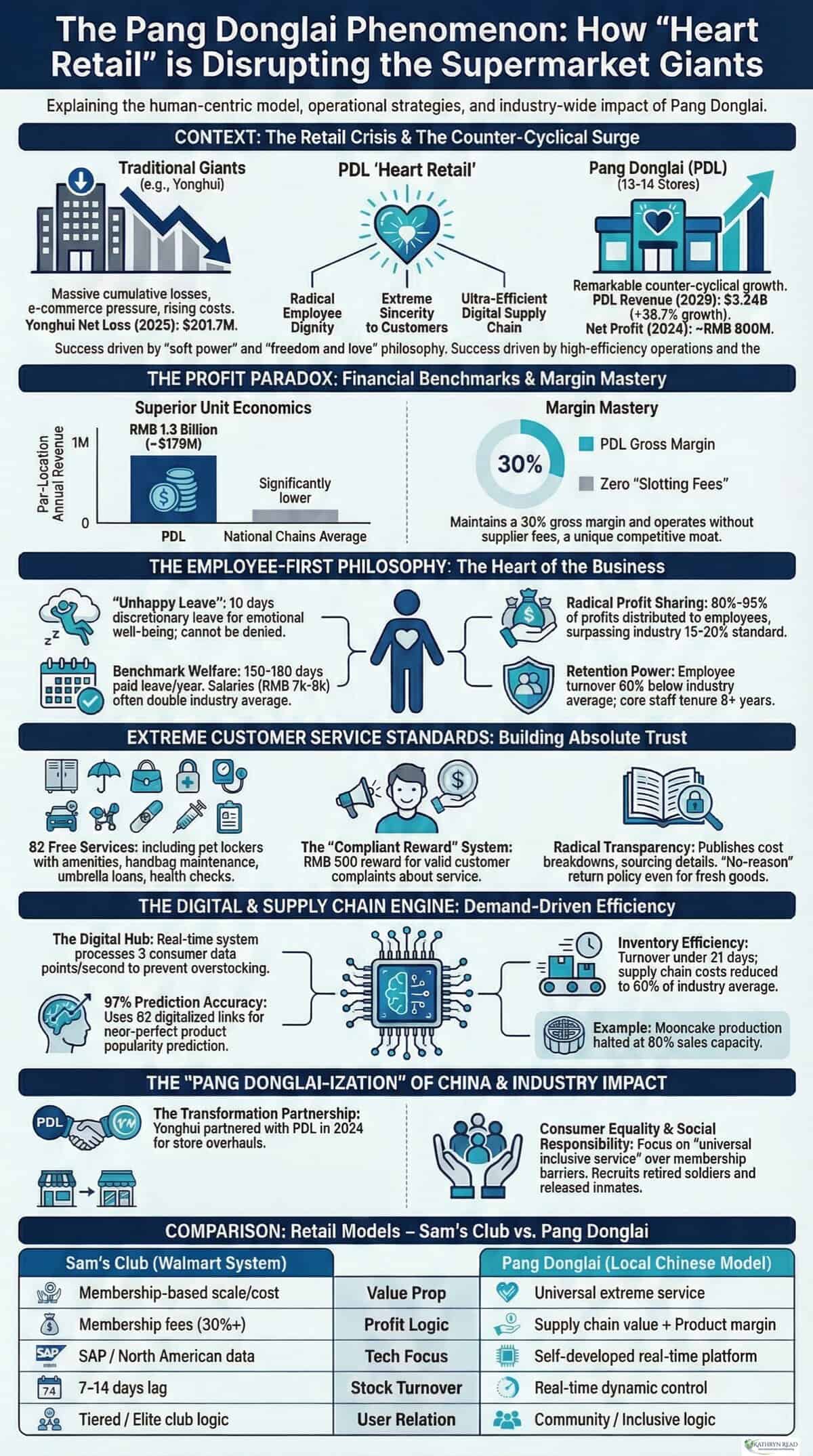
Pangdonglai’s rise is often studied by national giants and international retailers alike. While chains like Yonghui reported a net loss of RMB 1.47 billion ($201.7 million) in 2024, Pangdonglai generated over RMB 800 million ($110.2 million) from its 13 stores. That equates to a per-store profit nearly double that of comparable locations like Aldi China, with annual revenue averaging RMB 1.3 billion ($179 million) per store. Its gross margin of 30% is significantly higher than the 21% industry average, and its inventory turnover of under 21 days is five times more efficient than competitors.
These figures are no accident. They are the measurable outcome of five interlocking pillars, which form the backbone of the Pangdonglai winning strategies.
For FMCG suppliers, these numbers matter because they signal something critical: sell-through discipline. A retailer turning stock in under 21 days with a 30% gross margin is not just efficient. It is highly selective. That has implications for SKU rationalisation, listing negotiations, promotional planning and cashflow assumptions (which are often overlooked by brands entering China). Pangdonglai is not a dumping ground for inventory, but a high-performance environment.
As many brands’ marketing strategies in China are focused around price wars, PDL is charging a premium for higher quality products and a nicer experience in stores, and doing very well as a result. Although the model hasn’t yet been stress-tested on scale, it is a nice reminder that good old fashioned retail can be lucrative when the basics are done well, and relevant trends are supported.
China Skinny
Pangdonglai Success Principles: Regional Deepening Over Scale Heroism
Unlike national chains chasing rapid geographic expansion almost at any price, Pangdonglai focuses on what it calls “regional deepening.” Its stores dominate fourth-tier urban ecosystems such as Xuchang, creating dense, high-frequency shopping circles. Residents of Xuchang visit Pangdonglai on average 6.7 times per month, treating the store as part of their daily lives rather than just a place to shop. This is in contrast with first-tier city models, such as Sam’s Club in Shanghai, which operate under an “elite club logic,” charging membership fees and targeting high-net-worth consumers.
The learnings for foreign brands are clear. Instead of rushing to first-tier cities, international retailers could opt to establish strongholds in high-potential lower-tier markets where they can control quality, integrate deeply into communities, and foster repeat visitation. The concentrated footprint of Pangdonglai also allows for operational efficiency, as localised supply chains and regional procurement reduce logistics costs by 15–20% compared with national chains.
This doesn’t only translate for retailers – targeting lower tier cities for the start can be a positive strategy also for FMCG brands who are looking to find their feet in the market. Prioritise quality of footprint over number of stores and consider establishing high‑density urban hubs that build community loyalty before thinking about aggressive expansion.
When I did my first market entry in China with infant formula, we focused on (at that time) tier 2 – Tianjin, Wuhan, Chongqing, Hefei and Kunming. This worked because we were slightly away from the red ocean that is Beijing/Shanghai/Guangzhou, it was cheaper to enter AND (most importantly) we had motivated regional distributors who were willing to throw themselves into focusing on this new brand. So I’ve experienced first hand how this can work!
For context, I’d also add that the difference in lower-tier markets is often not just cost, but psychology. Distributors are less distracted, local governments are often more supportive, and competitive noise is lower. That combination can give you as an imported brand the breathing room to build velocity before facing national scrutiny.
Radical Profit Sharing Drives Extreme Service
At the heart of Pangdonglai’s strategy is its human-centred philosophy, often described as “Heart Retail.” Founder Yu Donglai distributes 80–95% of profits back to employees, transforming staff into highly motivated partners. Frontline employees earn between ¥7,000 and ¥9,000 per month, compared to the local industry average of ¥3,000–¥3,700. They enjoy up to 180 days of paid leave, including 10 days of discretionary “Unhappy Leave” to support emotional well-being.
This employee-centric approach produces measurable commercial results. In Xuchang stores, the per-transaction value is RMB 258 – 2.8 times the industry average. Repurchase rates reach 91%, sales density exceeds ¥80,000 per square metre (2.3 times that of local competitors), and employee turnover is 60% lower than the industry norm. Every single yuan invested in employee welfare multiplies into customer loyalty, higher transaction values, and reduced recruitment costs. The broader community and logistics ecosystem also benefit: in Zhengzhou, every ¥1 spent at Pangdonglai generates an estimated ¥3.7 in related industries.
The lesson for international brands is that high-welfare policies are not simply charitable or “cost factors”. They can be commercial multipliers, turning employee satisfaction into tangible customer and financial performance. Pangdonglai motivation advice shows that treating employees as partners rather than cost tools drives a culture of “extreme service” that cannot be replicated by training manuals alone.
However, for most companies, redistributing 80% or more of profits would be structurally impossible. The lesson is not the percentage. It is about the alignment mechanism and the question of how frontline teams are incentivised to care about basket size, repeat purchase and customer retention. (This is a key point for both retailers and brands.) If the answer is a generic bonus scheme, you are nowhere near Pangdonglai territory.
Extreme Transparency Builds Radical Trust
Transparency is another important pillar of the Pangdonglai model. Its Every Day Low Price strategy, “no-reason return” policy, and public cost breakdowns foster trust and remove friction from the shopping experience. Customers have the confidence that they are being treated fairly, rather than feeling like “big retail” is treating them simply as cash cows…
In China’s crowded retail environment, trust is a real differentiator. It isn’t something that you have by default, but has to be earned.
This trust translates into repeat business and word-of-mouth promotion. The Pangdonglai business model proves that this isn’t some kind of fluffy ideal but really a measurable asset that enhances both customer loyalty and bottom-line profitability.
In rare cases, Pangdonglai has even rewarded customers for whistleblowing on food safety issues, offering significant compensation for reporting problems and publicly refunding thousands of affected orders. This kind of “reputational moat” is rare.
In a market still shaped by past food safety scandals and uneven enforcement standards from one province to the next, proactive transparency carries disproportionate weight. For imported brands, this is particularly relevant because country of origin alone no longer guarantees trust in the way that proof, visibility and responsiveness do.
You can see this demonstrates the importance of moral authority in a market where consumers are increasingly sceptical of foreign companies. Pricing, sourcing, and service policies have become tools for the chain to build emotional connection rather than transactional loyalty in a market where that feels scarce. Pangdonglai success principles emphasise that transparency must be operationalised as a strategic advantage, shaping customer perception and embedding trust into the shopping experience. If you don’t practice what you preach then you have no chance of retaining consumer trust beyond the initial purchase.
All of this goodwill would collapse though without operational discipline behind it.
Pangdonglai Secrets to Success: the Digital Supply Chain as a Core Skill
Pangdonglai’s operational backbone is its digitised supply chain. Their self-developed digital middle platform enables a “reverse supply chain,” which produces based on real-time sales data rather than traditional headquarters forecasts. (Don’t get me started on the inaccuracy of this kind of gut-forecast in many cases)
Highlights include
- AI-driven predictive analytics that forecast product trends 48 hours in advance
- inventory turnover under 21 days
- local sourcing of up to 85% of products
- collaborative alliances with other regional retailers under a “one-negotiation, four-share” model
The uncomfortable question for many foreign brands is this: do you even have clean, integrated data that could plug into such a system? In my experience, fragmented ERP systems and distributor opacity often make real-time responsiveness impossible. Pangdonglai’s advantage is in data discipline, not simply technology.
These innovations allow Pangdonglai to maintain exceptional service levels even whilst scaling regionally. As an international brand, this is a critical lesson for you to understand: digital tools, applied to physical retail, enable ever more precise responsiveness and high operational efficiency. The Pangdonglai lessons for success show that e-commerce-style analytics, when combined with local knowledge, can avoid SKU stagnation and enhance community engagement.
This is where culture stops being philosophy and becomes process. (And at the risk of heading off on one of my pet rants, working without properly defined clean processes is one of the most costly mistakes I see companies making!).
Pangdonglai lessons for success: Customer service translates into hard power
Service is not an afterthought at Pangdonglai, but is deeply embedded in the operational DNA. Its 121 job manuals and 428 service rules cover every detail ranging from six-step watermelon slicing to over 100 free in-store services like pet lockers, umbrella lending, and blood pressure checks. Stores transform into community hubs and even tourist attractions.
International brands can learn that this kind of systematised service creates emotional differentiation at a level impossible for competitors who rely solely on product assortment or pricing. Service innovation isn’t a “nice to have” ornamental decoration, but rather a core pillar of profitability and customer engagement. This approach embodies one of the most potent Pangdonglai winning strategies: turning kindness into measurable business outcomes.
Why Fourth-Tier Cities Make the Model Work
Pangdonglai’s success is closely tied to the socio-economic environment of fourth-tier cities. Several factors amplify the model’s effectiveness here:
- Community Collective vs Elite Club: Residents value inclusivity, treating stores as essential community spaces rather than exclusive clubs (yes Sam’s Club it’s you who’s meant here).
- Labour Advantage: High wages relative to local costs foster loyalty and reduce staff turnover.
- Market Density: Dense store placement prevents competitors from gaining a foothold.
- Operational Efficiency: Local procurement and regional logistics reduce costs by 15–20 per cent.
Scaling this model to first-tier cities is far more difficult due to the higher labour costs, intense competition, and shareholder pressures in publicly traded firms there. The extreme service model requires 2.5 times the industry-standard staff allocation, which is feasible in smaller cities but would be challenging in high-cost urban centres.
For context, this fundamentally changes the cost structure. Labour as a percentage of revenue increases considerably. The model only works because high sales density and repeat visitation offset that burden. Without that density, the maths collapses. In other words, the model works because its cost base, wage expectations and consumer density are structurally aligned. Remove any one of those variables and the economics become fragile.
Commercial ROI of Employee-Centric Policies
Pangdonglai’s investment in employee welfare generates clear commercial returns & competitors have started jumping on the bandwagon.
Yonghui stores renovated following the Pangdonglai model saw daily sales increase from RMB 200,000 to RMB 1.6 million. Customer visits jumped from 3,000 to over 14,000 per day. Average per-store profitability is approximately RMB 61 million annually, with inventory turnover five times more efficient than the industry average. Lower employee churn reduces recruitment and training costs, demonstrating a direct multiplier effect where each yuan invested in staff generates secondary economic benefits across logistics, local food services, and community commerce.
Viral Marketing and Social Amplification
Pangdonglai’s rise to national attention was catalysed by social media virality rather than traditional advertising. Platforms like Xiaohongshu (Little Red Book/Rednote) showcased meticulous store layouts, WeChat mini-programs handled over 120,000 orders per day during epidemic restrictions, and Douyin live-streaming created “viral-ready” moments in-store. Radical policies (especially for China!), such as “Unhappy Leave” and hiring retired soldiers or former inmates, generated massive earned media attention.
This strategy transformed stores into tourist attractions with no off-season, driving 1.1 million shoppers in just three days across three supermarkets during the 2024 Spring Festival. Pangdonglai motivation advice demonstrates that emotional resonance, transparency, and operational ingenuity can outperform the traditional kind of paid campaigns.
Lessons for International Brands
Pangdonglai offers a “Third Path” for foreign brands, combining highly efficient infrastructure with human-centric soft power. The table below summarises what would be transferable as well as the inherent barriers. Not everything here is replicable though, and pretending otherwise is dangerous.
| Feature | Transferability | Core Barrier |
|---|---|---|
| Digital Supply Chain | High | Requires significant IT investment |
| Service Standards | High | Needs rigorous training and manualisation |
| Strategic Restraint | Medium | Conflicts with “scale-at-all-costs” mandate of most chains |
| Community Embeddedness | Medium | Requires long-term local presence and cultural fluency |
| Profit Sharing (80%+) | Low | Incompatible with shareholder-first capital models |
| Labour Density (2.5x) | Low | High operational costs in first-tier cities |
So you can see, this isn’t a “copy-paste” model, but more of a “choose your own adventure” selective learning exercise.
Key takeaways for foreign brands include implementing a reverse supply chain with localised procurement, systematised extreme service, employee-centric ROI, and strategic restraint focused on high-density regional hubs. Focusing on those high-density, high-quality regional hubs can deliver superior unit economics while maintaining customer trust.
Selective adoption requires discipline. Borrow the mechanics, not the mythology.
As the Pangdonglai story shows, some aspects (especially the radical profit redistribution, fourth-tier economics, Daoist-inspired leadership philosophy, and bespoke local government support) are deeply local and difficult to transplant, however the principles of operational precision, emotional engagement, and community integration remain universally applicable at least in part.
There is more than one route to succeeding in China
Pangdonglai demonstrates that kindness, trust, and digital efficiency are not soft ideals running contrary to the principles of “good business sense”, but managed correctly they become hard commercial levers. By treating employees as partners, service as an operational imperative, and digital systems as the backbone, this modest regional chain has outperformed giants such as Walmart, captivated the nation, and drawn international attention.
For brands entering China, the Pangdonglai example provides a roadmap for emotional profitability, strategic restraint, and operational ingenuity. In a market where consumers are discerning and digital channels amplify reputation instantly, emotional resonance and human-centred strategy can yield returns far beyond what sheer scale or capital investment can achieve. Even if full replication outside fourth-tier cities is limited, the lessons of employee loyalty, service excellence, and localised efficiency are applicable to any retailer seeking sustainable, profitable, and socially resonant growth.
This is a website more designed for FMCG brands though than international retailer, but I hope that the breakdown of the model’s success gives you a short insight into alternative approaches in China. The Pangdonglai secrets to success are not a checklist of things you need to apply to your business strategy. I wanted to give you a way of interrogating your assumptions about growth, people, and control in China. Just as a quick reminder:
Actionable moves for brands:
- Using real‑time demand data and local procurement can enhance your supply responsiveness.
- Building systematic service processes will reinforce emotional connection.
- Treat employee welfare as a commercial advantage, not an HR expense.
- Consider pursuing regional strongholds rather than premature national coverage.
Maybe one last thought from my side: If your China strategy relies on scale before trust, efficiency before empathy, or headquarters certainty over local reality, the Pangdonglai model should make you uncomfortable. Do you need to think again?
That, ultimately, is why the Pangdonglai secrets to success matter. Not because you can replicate them wholesale, but because they expose the blind spots in conventional China strategy. Depth over breadth. Trust before scale. Process before slogans. If those priorities feel misaligned with your current approach, that tension is precisely the point.
Thinking that working with a consultant would accelerate your international expansion?
If you’d like to learn more about working with me for support on your internationalisation projects or personal export knowledge, you can book a 30 minute international clarity call here.
If you haven’t already signed up for my free e-book about how to select which international market to enter next, you can do so here, or using the form below.
If you enjoyed this content please share it on social media or recommend it to your network.
Pin this post for later!

Kathryn firmly believes that business is done between people, and therefore places her focus on building strong relationships that form a solid foundation for doing business.
When she's not travelling around the world, Kathryn enjoys playing clarinet in her town's wind orchestra or sharing her love of the outdoors with her Scout group.