
For many years, personal branding was often viewed as something that belonged to celebrities, motivational speakers and social media influencers, and the idea of cross cultural personal branding simply wasn’t a consideration.
For business owners, particularly those in traditional B2B sectors, it was frequently regarded as a nice-to-have (or even “only for people who are WAY too convinced of their own importance”) rather than a necessity. If you had a strong company brand, a professional website and a good product, surely that was enough?
Today, that assumption looks increasingly outdated.
Before agreeing to a meeting, potential distributors will search for you online. Investors will look at your LinkedIn profile. Journalists will review your content before deciding whether to interview you. Potential customers will form opinions about your expertise long before they visit your website. In many cases, people encounter the individual behind the company before they engage with the company itself.
This is particularly true in international business.
When entering a new market, trust is often the most difficult thing to establish. Prospective partners may have never heard of your company however well known you are in your home market. They may not only have no prior experience of your products but also might have dozens of competing suppliers to choose from.
What they can evaluate, however, is you & how you appear online, meaning that increasingly, business leaders themselves have become part of the international marketing mix.
This was one of the themes explored during episode 36 of International Expansion Explained, where I spoke with executive ghostwriter and personal branding strategist Pooja Marwah about the role of personal branding in international business.
We didn’t just talk about LinkedIn posts and social media tactics though as there are loads of people covering those topics. Instead, our conversation revolved around trust, culture, storytelling and the challenge of building influence across borders. Perhaps the most important takeaway was that while personal branding is often discussed as a universal concept, successful personal branding is rarely universal in its execution.
The qualities that help somebody build credibility in New York may not be the same qualities that resonate in Dubai. The communication style that works in London may not work in Mumbai. The type of content that attracts attention in Australia may be viewed quite differently in Japan.
Just as products and marketing campaigns require adaptation when entering new markets, personal brands need a degree of cultural calibration too.
The challenge is learning how to adapt without losing yourself in the process.
Table of Contents
Let me introduce Pooja Marwah
When discussing personal branding, it is easy to find advice from people whose experience is largely confined to a single country or platform, or who are truly overly convinced of their own importance…

What makes Pooja’s perspective particularly interesting for me is the international nature of her work.
As an executive ghostwriter and personal branding strategist, she works with founders, investors, senior executives and public figures across multiple countries and industries. Her role involves helping high-profile individuals articulate their ideas, share their expertise and build visibility while remaining authentic to who they are.
This work gives her a unique vantage point.
While many people discuss personal branding in theory, Pooja sees firsthand what happens when communication styles cross borders. She observes how messages are received by different audiences, how cultural assumptions shape perception and how subtle changes in tone can dramatically affect engagement.
One of the ideas she returned to several times during our conversation was her definition of personal branding as the “conscious expression of values and voice”.
I particularly liked this definition because it moves the conversation firmly away from vanity metrics and self-promotion.
Too often, personal branding is reduced to a discussion about followers, likes and visibility. Yet the people Pooja works with are not aspiring influencers. They are founders, investors, business leaders and policymakers whose objectives are usually very different.
They are not trying to become famous – they are trying to become trusted.
That distinction matters because it changes the purpose of personal branding entirely and brings cross cultural personal branding right into the frame of international expansion as I personally believe it SHOULD be done
Instead of asking, “How can I attract more attention?”, the more relevant question is, “How can I build trust with the people who matter most to my business across the world?”
For companies operating internationally, that question is becoming increasingly important as trust is possibly the single most important currency that a brand can possess in today’s overwhelming sales environment. .
Why Cross Cultural Personal Branding Has Become Essential for International Business
One of the biggest misconceptions about personal branding is that it only matters in consumer-facing industries.
In reality, some of the strongest examples of personal branding can be found in highly technical, specialised or industrial sectors.
Over the years, I have worked with manufacturers selling products as diverse as baby food, skincare, kitchenware and industrial equipment. While these businesses may have little in common on the surface, they often share one challenge when expanding internationally.
They need to build trust (& fast), however that trust rarely develops through brochures alone.
A distributor considering a new supplier wants confidence in the people behind the business. An investor wants confidence in leadership. A retailer wants confidence that a brand owner understands their market. Even government agencies and trade organisations often prefer working with individuals they perceive as credible and knowledgeable…. & this is where cross cultural personal branding becomes a strategic asset.
Pooja describes personal branding as a passport to trust, visibility and influence (& passports are key in international business!).
A strong personal brand can open doors that might otherwise remain closed, which is part of why personal branding is important.
It can create opportunities to speak at conferences, contribute to industry publications, participate in government delegations or build relationships with key decision-makers. It can help establish expertise before a conversation even begins. In many ways, it acts as a form of social proof. I was invited to speak at an industry event in Switzerland the other month – that invite would never have come my way without my online presence and contributions in industry media, but it works equally for brand owners: not only service providers such as myself.
When somebody searches for your name and finds thoughtful commentary, useful insights and evidence of experience, they are already forming positive impressions. By the time you sit down for a meeting, part of the trust-building process has already taken place.
This is especially valuable in international markets, where face-to-face contact may be infrequent (& is extremely expensive) and where buyers often have limited information available about potential partners.
Personal branding therefore becomes more than a “fluffy” marketing activity and is one of your relationship-building tools.
Why Personal Branding Doesn’t Look the Same Everywhere (or “Personal Branding and Cultural Nuances”)
One of the most interesting aspects of my conversation with Pooja was how closely the principles of personal branding mirror the principles of international marketing. (Of course this is somehow obvious, but it’s still fascinating to see this topic through the eyes of someone who comes from a completely different specialisation to my own).
When businesses enter a new market, they can’t assume that everything can remain exactly the same. They need to recognise that consumer expectations, retail structures, communication preferences differ. Sometimes even the colour of a package or the name of a product must change to fit local expectations, and it’s the same with personal branding in international marketing.
Yet when it comes down to it, many professionals unconsciously assume that authenticity means communicating exactly the same way everywhere. That’s an assumption (like most other assumptions, but don’t get me started) that can create problems though.
I mentioned above Pooja’s definition of personal branding as the conscious expression of values and voice. Importantly, she didn’t define it as the rigid expression of personality regardless of context. There’s a subtle but important distinction between those two approaches.
During our discussion, Pooja highlighted how different regions often respond to very different communication styles.
In the United States, business audiences frequently reward confidence, boldness and strong personal positioning. A founder who openly shares opinions, demonstrates personality and projects individual achievement may be viewed positively.
European audiences often place greater emphasis on expertise and evidence. While personality certainly has a role to play, credibility is frequently built through thoughtful analysis, demonstrated knowledge and carefully reasoned arguments. An American who turns up and is “larger than life” is likely to be perceived as brash and perhaps even taken less seriously.
Across many Asian markets, reputation and authority continue to carry significant weight. Expertise often needs to be established before personality becomes the focus. Professional standing, experience and demonstrated competence can be critical trust signals. I posted recently on LinkedIn that the German often trusts a company first whereas an Asian may trust an individual based on the relationship they have to the person who made the introduction – that’s a clear example of how this trust building can vary across geographies.
Meanwhile, in many Middle Eastern markets, relationship-building, community and shared values often play a particularly important role in how trust is established.
Of course, these observations are broad tendencies along a spectrum rather than universal truths. Every country is different. Every industry is different. Every audience is different & so is each individual.
However, the principle remains important.
People in different markets often look for different signals before deciding whether someone is credible, trustworthy or worth engaging with & the challenge for internationally minded business leaders is learning how to recognise those signals and respond appropriately without losing the qualities that make them distinctive.
As Pooja put it during our discussion, discretion does not mean dilution.
That may be one of the most useful pieces of advice for anyone building a global personal brand. Adapting your communication style does not require abandoning your personality. It simply requires understanding your audience.
The Three-Lens Framework for Cross Cultural Personal Branding
One of the most practical ideas that emerged from our conversation was Pooja’s suggestion that personal branding across cultures should be viewed through three separate lenses: cultural resonance, brand promise and personal comfort.
I found this framework particularly useful because it balances two competing realities.
On the one hand, successful international business requires adaptation. Companies that refuse to adapt often struggle to gain traction in new markets. On the other hand, if a business owner adapts too much, they risk becoming inauthentic and losing the qualities that made them distinctive in the first place.
These three lenses help create a middle ground – it’s that sweet spot in a Venn diagram!
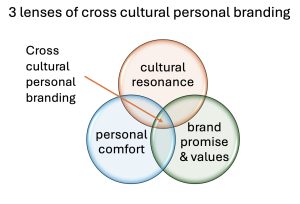
Cultural Resonance
The first lens asks a simple question: does your message make sense within the cultural context of the audience receiving it?
Many exporters already understand this principle when it comes to products and marketing campaigns. They recognise that consumer expectations differ from market to market. What appeals to consumers in Germany may not appeal to consumers in Vietnam. The same applies to communication.
Pooja suggested something straightforward as a starting point for understanding a new market: study its advertising.
Watch television commercials. Look at billboard campaigns. Observe social media content from local brands. Pay attention to how authority figures are portrayed, how humour is used and how success is defined.
This advice mirrors the market research process I often recommend to clients. Companies sometimes become so focused on formal market reports that they overlook the enormous amount of cultural intelligence available in everyday observations.
Remember: Advertising reveals what a society values.
It shows whether expertise matters more than personality. It reveals whether humour is celebrated or used cautiously. It demonstrates how family, community, status and achievement are presented.
Equally important is understanding what Pooja referred to as cultural non-negotiables.
Every market has topics, behaviours or communication styles that may create friction. Sometimes these are obvious but often they are subtle.
A joke that works perfectly in one country may be misunderstood in another. A casual communication style that feels approachable in one market may appear unprofessional in another.
This does not mean business leaders should become overly cautious or fearful of communicating. It does mean you need to recognise that successful communication begins with understanding the audience rather than simply expressing ourselves.
Brand Promise
The second lens focuses on value.
What does your brand actually promise the people you are trying to reach?
One of the mistakes I frequently see in both corporate marketing and personal branding is an excessive focus on what the business wants to say rather than what the audience wants to hear. (I’m sure you’ve heard the saying that a worm has to be tasty for the fish, not the fisherman?)
When entering a market such as the UAE, for example, the question is not simply what products or services you offer. But how does your expertise improve the lives, businesses or outcomes of the people you are trying to serve?
This may sound obvious, yet many personal brands are built almost entirely around the individual. Their achievements. Their experiences. Their opinions. (And we won’t mention those idiots who post photos of themselves in front of someone else’s Ferrari – the business equivalent of fishermen’s “tall tales”)
There is certainly a place for all of those things (except the fake “I’m so successful I have a Ferrari” pics obviously). The most effective personal brands connect individual expertise to audience benefit though. This is particularly important in international business because buyers, distributors and investors are not just looking for another interesting personality. They’re looking for somebody who can help them solve a problem, reduce a risk or create an opportunity.
A personal brand should therefore function as a bridge between expertise and relevance.
Personal Comfort
The third lens may be the most important.
How do you adapt without becoming somebody else?
Pooja’s answer was simple: discretion does not mean dilution.
I suspect this is where many people become uncomfortable with discussions around cultural adaptation. They fear that adapting communication styles somehow requires abandoning their values or suppressing their personality, whereas in reality, successful international business has always involved adaptation.
Most people naturally behave slightly differently when attending a trade show in Tokyo than they would at a networking event in London. They become more aware of local customs, adjusting their communication style & demonstrating respect for local norms.
Nobody would argue that this makes them inauthentic.
The same principle applies online.
The goal isn’t to create a different personality for every market. Your goal is to operate within a corridor of behaviour that remains true to your values while recognising the expectations of different audiences.
Storytelling is the Universal Language of International Business
One theme surfaced repeatedly throughout our conversation: storytelling.
Pooja described storytelling as a superpower, and I think that’s true.
In international business, we often assume that decisions are driven primarily by facts, figures and rational analysis. Yet anyone who has spent time working internationally knows that relationships, trust and emotions often matter more.
People may justify decisions rationally, but they rarely make decisions rationally alone.
Pooja shared an example of a CEO who was struggling to connect with Middle Eastern investors. Her content was technically strong and factually accurate, yet it wasn’t generating the engagement she’d hoped for.
The solution wasn’t changing the underlying business proposition: It was changing the narrative… By moving from a purely clinical explanation of the business towards a story centred on community impact and shared outcomes, she was able to connect more effectively with the audience she was trying to reach.
This example highlights something many exporters experience when pitching internationally. The same facts may remain true across markets but the story surrounding those facts often needs to adapt.
I have seen businesses present themselves very differently depending on whether they are speaking to retailers, distributors, government agencies or investors. Not because they are changing who they are, but because different audiences connect with different aspects of the story.
Stories create context helping people understand why something matters. They make expertise memorable, and, most importantly, they humanise business. This becomes particularly valuable when dealing with technical products, complex services or innovative technologies. Facts explain what something does but it’s the stories that explain why somebody should care.
LinkedIn, Instagram and Choosing the Right Platform
Another interesting aspect of our discussion was the role of different social platforms.
Many people approach personal branding as though every platform serves the same purpose. In reality, each platform has its own culture, audience expectations and communication style (as you will have discovered if you simply post the same content with exactly the same framing to each platform and watch it bomb on all but the one it was intended for originally).
LinkedIn remains the dominant platform for professional personal branding, particularly among founders, executives and consultants.
What makes LinkedIn powerful is not simply its reach but its context. People arrive on LinkedIn expecting to discuss business, leadership and professional development. They are actively looking for expertise, insight and useful perspectives.
Instagram operates differently.
The platform is more visual, more immediate and often more personality driven. Content tends to be consumed more quickly and attention spans are shorter. Pooja noted that shorter video formats often perform particularly well here.
The lesson is not that one platform is superior or more relevant – it’s that different audiences consume information differently.
The most successful personal brands understand this and adapt accordingly.
Perhaps the most useful point Pooja made concerned metrics. Too many people are obsessed with follower counts. For business leaders, though, visibility among the right audience matters far more than visibility among a large audience.
A founder selling industrial equipment does not need millions of followers. They need the right distributors, buyers and decision-makers to notice them.
Quality almost always beats quantity.
AI, Authenticity and the Human Voice
No conversation about content creation can avoid the subject of AI these days.
Like many people working in communications, Pooja has embraced AI as a productivity tool rather than viewing it as a threat.
Her perspective is similar to mine: AI can help generate ideas, improve efficiency and reduce administrative workload. It can accelerate content production and support research.
What it can’t reliably do is replicate the human nuance which is particularly important in cross cultural communication. While AI can identify broad cultural patterns, it struggles with context, subtlety and emotional intelligence. It can tell us what is generally true but is far less effective at understanding what is appropriate in a specific situation involving a specific audience.
Pooja also spoke about the importance of voice.
One of the reasons she personally writes for many of her clients is because voice is highly individual. It develops through conversation, observation and understanding.
This is an important reminder at a time when many professionals are using AI to create content at scale, that each of us has an individual style and whilst efficiency is valuable, authenticity remains essential.
The danger is less that AI will replace human voices & more that people will stop developing their own because it’s less effort to rely on Chat or Claude…
What Gen Z Gets Right and Wrong
One of the more entertaining parts of our conversation centred on generational differences.
Pooja noted that younger generations often possess an intuitive understanding of digital platforms that older professionals struggle to match. They understand trends & platform mechanics as well as how attention moves online. In many ways, they are natural communicators within digital environments.
However, Pooja also observed that younger generations can sometimes underestimate the importance of cultural context. She illustrated this with a story about her daughter insisting on wearing a crop top to a shopping centre despite her mother’s warnings that it might attract unwanted attention. Fifteen minutes later, she was asking for the jacket her mother had thoughtfully packed.
Many younger professionals have grown up in an interconnected digital world where communication feels increasingly global. As a result, there can be a tendency to assume that norms are universal.
International business quickly teaches otherwise, as I’m sure most of you know already.
Understanding audiences remains just as important as understanding platforms.
Perhaps the ideal approach combines the strengths of both generations: digital fluency paired with cultural awareness.
Common Mistakes in Cross Cultural Personal Branding
As our discussion drew to a close, we reflected on some of the mistakes people commonly make when building personal brands internationally.
The first is copying content.
Templated content may be easy to produce (there are many businesses who sell these kinds of templates), but it rarely creates genuine connection because audiences can usually tell when content lacks originality. It’s a bit like language learning – it’s useful to use templates to learn how the structures work, but to become truly fluent you need to construct your own sentences from scratch.
The second is chasing visibility at the expense of relevance.
Many professionals become obsessed with followers, likes and engagement metrics even though those won’t pay the bills. In the end, success depends on attracting the right audience rather than the largest audience.
The third is neglecting cultural research. Branding mistakes often occur not because somebody intended offence but because they failed to understand the audience they were trying to reach.
Another common mistake is confusing authenticity with a refusal to adapt. Authenticity does not require saying everything that comes to mind. Nor does it require behaving exactly the same way in every situation. Professionalism, respect and cultural awareness are not enemies of authenticity. They are often prerequisites for meaningful relationships.
Finally, there is the temptation to make the brand entirely about yourself. The strongest personal brands are rarely self-centred, but focus instead on serving an audience. As Pooja observed, audiences are the reason personal brands exist in the first place. When people genuinely listen to their audience, they often find the answers they are looking for.
Full discussion and some final thoughts
You can watch the full discussion with Pooja here:
Too many people fail to realise that cross cultural personal branding is never really about social media but far more about trust.
International business has always been built on trust. Of course products, pricing & distribution matter. But relationships remain at the heart of almost every successful international expansion story and that’s why it was such fun for me to dive into this topic with Pooja.
In an increasingly connected world (I mean even the phrase has become cliched!), personal brands have become one of the ways those relationships begin.
The challenge is to build a reputation that travels as far as you’d like your products to! It’s not about visibility or fame (although a certain amount of visibility is needed for you to communicate your message). You need to communicate your expertise in a way that resonates across cultures.
That means adapting without losing authenticity & understanding audiences without abandoning your own voice. As I said earlier in this post, in many respects, building a cross cultural personal brand is not so different from building an international business. Both require curiosity, empathy & a willingness to listen…. And both ultimately depend on earning trust from people whose experiences, assumptions and expectations may be very different from our own.
That balancing act is unlikely to become easier in the years ahead.
If anything, it may become one of the defining skills of successful international business leadership.
Thinking that working with a consultant would accelerate your international expansion?
If you’d like to learn more about working with me for support on your internationalisation projects or personal export knowledge, you can book a 30 minute international clarity call here.
If you haven’t already signed up for my free e-book about how to select which international market to enter next, you can do so here, or using the form below.
If you enjoyed this content please share it on social media or recommend it to your network.
Pin this post for later!

Kathryn firmly believes that business is done between people, and therefore places her focus on building strong relationships that form a solid foundation for doing business.
When she's not travelling around the world, Kathryn enjoys playing clarinet in her town's wind orchestra or sharing her love of the outdoors with her Scout group.