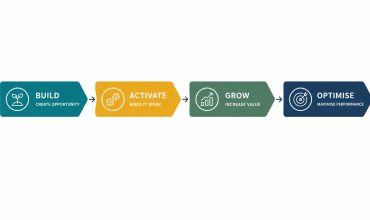
There’s a pattern I see repeatedly in international expansion where a brand has a genuinely good product. The timing feels right, the market opportunity looks real and yet, twelve months later, nothing much has happened – or worse, something expensive has gone wrong.
It’s rarely the product per se that’s the problem. It’s rarely even the market. It’s the absence of a disciplined, repeatable process (ie an international expansion strategy framework) for making decisions at each stage of the journey – one that holds up not just on a slide deck, but in the messy, unglamorous reality of cross-border trade.
After years of helping consumer goods brands find their feet in Asian markets and beyond, I’ve noticed that the brands which succeed consistently do four things well. Not perfectly, nor without setbacks. But with enough structure to make good decisions, learn quickly, and build something sustainable.
I’ve formalised those four things into what I call the R.E.A.D. Method: Research, Evaluate, Activate, Develop. This post is the full working version – what each stage actually involves, where brands typically go wrong, and what doing it properly looks like in practice.
Table of Contents
Why having an international expansion strategy framework matters (and why most brands don’t use one)
Before we get into the stages, it’s worth being honest about why often an international expansion strategy for consumer goods brands lacks any real structure.
Partly it’s enthusiasm. Maybe the CEO comes back from a trade trip buzzing about a market or a distributor rocks up to your stand at an exhibition and it feels like the obvious next step, destiny if you like… Perhaps a competitor appears to be winning somewhere and the fear of missing out kicks in. None of these are bad starting points to get you thinking a market may have potential but none of them are a strategy either.
Partly it’s the illusion that experience in one market transfers automatically to the next. Believe me, it doesn’t. The consumer goods brand that has done well in the Gulf can’t assume the same approach will work in Southeast Asia. The product that flies off shelves in Singapore won’t necessarily resonate in Indonesia, even though they’re separated by less than an hour’s flight. Or in European terms, you can’t compare the markets of Bulgaria and Romania even though they are simply separated by the Danube.
And partly it’s the sheer volume of noise. There’s no shortage of market reports, trade missions, export advisers, and conference panels telling you where to go and what to do. What’s rarer is a clear, honest process for working it out yourself – one that’s built around your brand, your category, and your actual capacity (& willingness) to execute.
That’s what the R.E.A.D. Method is designed to be.
R = Research: Beyond the desk
Real research isn’t just downloading a Euromonitor report and calling it done, nor is it dropping a prompt into an AI tool and accepting the output as gospel either. Both certainly have their place, but neither replaces direct, contextual knowledge of a market.

What you’re actually trying to understand at this stage is whether your product fits into how people in that market eat, shop, and think. Not whether a market is “growing” in a general sense (most Asian & many African markets are) but whether your specific product, at your price point, with your brand story, has a credible place in the competitive landscape and how it fits into the long term strategic aims of your overall business.
This means asking questions that reports can’t always answer. What are local competitors doing that imported brands aren’t? What does the in-store experience actually look like – not on a busy Saturday morning, but on a Tuesday afternoon when it’s quiet and you can actually talk to the staff? What do distributors say they can’t get enough of, and what are they quietly struggling to move? What are the conditions for key account listings, and can you realistically live with them?
It also means being honest about category dynamics that might not be obvious from the outside. When I worked in infant nutrition, I noticed a tendency to map infant formula trends onto broader food trends – assuming that the same drivers of premiumisation or clean-label were at work. Sometimes they were. But infant formula brands are ultimately selling trust. Parents want to know that a product is safe and that their child will thrive on it. Without that foundation of trust, the ingredient story almost doesn’t matter. That’s a very different commercial reality to, say, a premium snack brand – and your research needs to reflect it.
In the same phase of my career in infant nutrition, I was looking to enter into the market in Cyprus. My desk research suggested that taste was similar to the rest of the Eastern Mediterranean region so my initial thoughts on range were based on experience in South Eastern Europe, Turkey, Lebanon and Egypt together with our standard basic range. A market visit and distributor meeting turned that on its head & we launched with a stripped down range which included a hero item that was usually only a secondary priority listing: baby water. Going forward for the coming 18 years while I was in the company, that SKU remained a hero item making around 50% of revenue.
The discipline I’d encourage here: go visit in person. Do the store checks yourself, or engage someone you trust (reach out to me if you’d like help with this), and speak with companies who have a deep knowledge of the market . Make sure that you read the room, not just the international expansion data.
E = Evaluate: Taking the emotion out of market selection
Once you have real data – backed by your own observations, not just third-party reports – you need to make a decision. That means evaluating markets against each other, not just in isolation.
This is the stage where brands most commonly let emotion drive the bus.
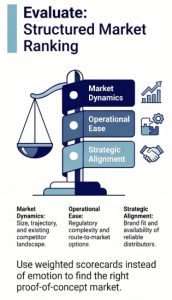
Maybe the CEO’s favourite market gets prioritised regardless of the commercial fundamentals & practicality. A random enquiry from a distributor at a trade fair gets treated as a market signal. A competitor’s apparent success somewhere creates pressure to follow – without anyone stopping to ask whether the competitor is actually making money there, or whether their brand profile is even comparable to yours.
The antidote is a structured evaluation. I use a weighted market ranking model with clients: a scorecard that looks at market size and growth trajectory, regulatory complexity and timeline to first sale, route-to-market options, the distributor landscape in your specific category, and brand fit – whether your story is likely to resonate with consumers there, and whether there’s genuine white space for you to occupy. Why would you want to try and battle your way into a dark red ocean?
The point isn’t to produce a definitive ranking that tells you exactly what to do. It’s to create a shortlist of three to five priority markets that you can defend rationally, and to take the wishful thinking out of the process. It’s important to remember that it’s better to choose one to focus on, rather than trying to start working on 5 to see which one moves fastest. What I would say though is that if you have a medium term plan to scale into a whole region, you may need to begin working on more than one market now, in the awareness that there may be a year’s ramp up period for product registration and formalities so pairing say Singapore with Indonesia for this could mean that you begin in a couple of months in Singapore, whilst the Indonesian bureaucracy takes “a bit longer” to get through.
Don’t forget, a population of 260 million means nothing if the regulatory burden is brutal, the cold chain is unreliable, and every distributor in your category is already tied up. You might be better off going into a smaller market closer to home that is perhaps less in the spotlight of your competition and where it’s easier to gain traction.
A word on China specifically. It comes up in almost every conversation I have with brands about Asia, and it deserves a direct answer. China is not the right first overseas market for most SME consumer goods brands. The complexity is real, the cash flow requirements are significant, and finding the right partners is genuinely hard. I’ve seen brands for whom everything worked – the partner, the listings, the consumer response – and they still couldn’t scale fast enough to capitalise on the opportunity before it closed. Better, in most cases, to build a proof of concept in a well-chosen mid-sized market first. The learnings are faster, the stakes are lower, and a track record in a comparable market makes you a more credible partner when you do eventually approach China.
It’s always up to you as a brand to make the final decision about whether to enter a specific market or not, and of course you can pretty much sell anything at any price point into any market…but the quantities may not be worth your while. So if you as an owner feel that your iconic packaging is core to your product, you might have to accept that it prices you out of the Philippines for larger volumes, or that it’s not acceptable by law in the GCC. It’s not logical on paper that any market in Southeast Asia would want infant formula packed in cardboard boxes that soak up humidity faster than you can say “packaging”…but the Philippines does, because the prices are cheaper than products packed in tins. You as a brand owner might find that ridiculous but you have to accept that delivering tins into the market will not only “differentiate” you from the competition in the sense of offering something better, but that you will be differentiated from a price perspective as well (leading to volumes that are let’s say “less desirable”).
One more thing worth saying: the evaluation stage isn’t a one-time exercise. Markets change, regulatory environments shift, distributors change ownership or merge with other companies. A market that wasn’t right two years ago might be worth revisiting now – and vice versa. Build the habit of reviewing your market priorities annually, not just at the start of an expansion project.
And one last point here, this international expansion strategy framework can be used also on selection of sales channels and distribution partners, not just at the market top level.
A = Activate: The stage where the expensive mistakes happen
If Evaluate is where strategy gets formed, Activate is where it either holds together or falls apart. This is the most operationally demanding stage of the R.E.A.D. Method – and the one where I see the most costly, avoidable errors.
The single most common failure in implementing the export strategy for consumer goods brands: a brand signs a distributor agreement, ships a few pallets along with a price list and a PowerPoint deck, and then waits. Six months later, nothing meaningful has been sold & the distributor seems disengaged. The relationship, which started with genuine mutual enthusiasm, has quietly gone cold.

What went wrong? Usually, several things simultaneously.
The brand assumed that the distributor would drive the business in-market without ongoing support. The distributor, meanwhile, has thirty other brands in their portfolio and will naturally prioritise the ones where the principal shows up, pays attention, and makes their lives easier. Without structure and accountability built in from day one, your brand slides down the priority list regardless of how good the product is because you’re simply lacking effective distributor management.
Activation done properly looks quite different. It starts with a genuine onboarding process: time spent making sure your distributor understands not just what your product is, but what your brand stands for, who your target consumer is, and what success looks like in the first twelve months. It includes a launch plan with realistic milestones – not just a shipment date, but agreed targets for distribution, shelf presence, and early sell-through.
It also means localising more than just your label. Your brand story needs to make sense in this market, to this consumer, at this point in time. That might mean adjusting your messaging, reconsidering your format range, or rethinking your hero SKU. What works at home won’t automatically translate and assuming otherwise is one of the most expensive mistakes a brand can make.
What steps are you taking to build the brand awareness? You can’t expect this to be done by a distributor (although they may do the execution under your supervision) – it is YOUR brand and therefore you need to be the ones driving the brand activation. Without that groundwork, it will be hard for the distributor to achieve listings and the levels of sale that you are both hoping and planning for.
There’s also a window of opportunity in the first 90 days of a new distributor relationship that most brands don’t use well enough. This is when your partner’s attention is most available, when the internal enthusiasm is highest, and when you have the best chance to demonstrate that you’re a principal worth prioritising. Show them that they matter to you. Be responsive. Turn things around quickly. Make the operational side of working with you as easy as possible. If the relationship is strong, it’s easier to weather challenges together, and the distributor has to have a clear impression of how he will in future be able to earn money with your products.
The first six to twelve months in a new market are rarely profitable. They are, however, decisive. The habits, structures, and expectations you establish in this period will shape the entire relationship going forward.
D = Develop: The long game
Getting listed is not the goal. Staying listed, growing distribution, and building genuine brand equity – those are the goals.
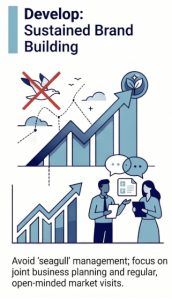
The Develop stage is where many brands go quiet, and where the best brands pull ahead. It requires a different kind of effort to the earlier stages: less about making decisions and more about sustaining relationships, staying curious, and being willing to adapt.
Practically, this means joint business planning with your distributors – agreed targets, clear KPIs, and regular reviews that are genuinely two-way conversations rather than one-sided performance interrogations. It means investing in brand building over time: not a one-off launch campaign, but sustained, locally relevant storytelling that embeds your product in the consumer’s consideration set.
It also means showing up. Regular market visits matter more than you may think in this age of video meetings – not just to check on performance, but to deepen your understanding of how the market is evolving and to strengthen your relationship with your partner. There’s a right and wrong way to do this though. Don’t be a seagull manager: flying in, making a lot of noise, telling everyone what they’re doing wrong, and flying out again having stolen everyone’s chips (& pooped on their heads). Go in ready to listen as much as to direct & guide. The best market visits I’ve been part of are ones where both sides come away having learned something.
Some markets are more of a slow burn than others and you feel like you are banging your head against a brick wall before the sales start to grow at a similar rate to other markets. Other markets start fast and plateau…
International markets don’t maintain themselves anywhere though. The brands that treat export as a long-term investment – not a short-term revenue line – are the ones still there five, ten, and twenty years later. First mover advantage is real, so if you’re in a market that you feel is perhaps too early stage for you to be mainstream, you have to decide whether you’re going to hang on in there or move onto somewhere more immediately lucrative. This is especially true if you are selling premium products in emerging markets where it can take several years to become properly established.
Post-Covid many European companies struggled with poor performance from their distribution partners in China. This was both a consequence of economic stagnation, but also often a feeling of being insignificant. Distributors hadn’t been visited for years and felt that they were no longer a priority to their suppliers so they drifted into focusing purely on the brands where profits were highest in the short term.
The loop, not the ladder
The R.E.A.D. international expansion strategy framework is a loop, not a ladder. Once you’re in the Develop stage in one market, you’re likely already in Research mode for the next.
A word of caution on that, though: don’t overly rush it. Your internal systems, your back office, your team’s capacity – these all need to evolve alongside your market portfolio. A brand that launches into five new markets simultaneously without the operational infrastructure to support them isn’t executing a strategy – it’s spinning plates, and something will eventually crash. Doing this leaves you with so many moving pieces that you can’t be sure what is working to drive growth or conversely causing the problems.
The brands that scale internationally aren’t necessarily the ones with the best products or the biggest budgets. They’re the ones with a smart strategy and the most disciplined process. The ones who ask hard questions early, make decisions based on evidence rather than enthusiasm, show up properly for their partners, and play the long game.
If you’re planning an international expansion – or trying to work out why an existing one has stalled – start by asking honestly: at which stage did the wheels come off?
Research skipped in favour of assumption. Evaluation hijacked by emotion. Activation treated as a handoff rather than a partnership. Development abandoned once the first shipment landed.
The good news is that none of these are fatal. The R.E.A.D. Method is a loop precisely because there’s always another chance to go back, do it properly, and build something that lasts.
If you’d like to talk through what that looks like for your brand, get in touch. That diagnostic conversation is usually where the real work begins.
Thinking that working with a consultant would accelerate your international expansion?
If you’d like to learn more about working with me for support on your internationalisation projects or personal export knowledge, you can book a 30 minute international clarity call here.
If you haven’t already signed up for my free e-book about how to select which international market to enter next, you can do so here, or using the form below.
If you enjoyed this content please share it on social media or recommend it to your network.
Pin this post for later!

Kathryn firmly believes that business is done between people, and therefore places her focus on building strong relationships that form a solid foundation for doing business.
When she's not travelling around the world, Kathryn enjoys playing clarinet in her town's wind orchestra or sharing her love of the outdoors with her Scout group.