There comes a point in every export manager’s life when gut feel isn’t enough – the distributor who once fuelled your growth starts slipping on the very distributor performance metrics that matter most. Loyalty can make you overlook the early warning signs, but when your partner stops delivering while your brand keeps accelerating, that loyalty quietly becomes a liability. I want to take a closer look at the signals hidden in the numbers, the risks of staying too long, and how to pivot to a better-fit partner without derailing your market momentum.
I’ve written about evaluating distribution partners before and doing a distributor performance review. It’s an exercise that I used to do on an annual basis when I was employed (in addition to more regular sales and marketing updates).
Table of Contents
Why might a distributor no longer be a good fit?
Before we go any further, it’s worth saying that this isn’t about hunting for “bad partners.” The real aim is to understand how you can optimise results together – and that starts with evaluating distributor performance in a structured, unemotional way.
Still, there does come a moment when the partnership simply stops delivering what the market requires. Sometimes this becomes obvious during a routine distributor performance review; other times it emerges more subtly through your ongoing distributor performance tracking. The reasons vary, but the patterns are familiar:
The owner becomes more invested in a larger, shinier brand elsewhere in the portfolio.
Personal distractions mean they’ve taken their eye off the commercial ball.
Cash flow becomes tight, slowing down orders or activation work.
You’ve grown, but they haven’t. The partner who was perfect for your needs a decade ago can now be too small or a poor fit for your ambitions.
The market itself evolves. I saw it clearly in infant nutrition when many territories in the former Soviet Union shifted from pharmacy-led sales into supermarkets and not every distributor had the appetite or capability to make that jump.
And beneath these surface-level causes, the numbers often tell their own story: slipping sell-out, erratic forecasts, widening KPI gaps, or activation that consistently lags behind the category. These are the early indicators within your distributor performance metrics that something has changed, and that the fit may no longer be what it once was.
The Signals Hidden in the Numbers (Early Red Flags)
The data usually starts dropping hints long before the inter-personal relationship feels strained. The trick is recognising the early tremors rather than waiting for the category earthquake. Some of the most telling distributor performance metrics to monitor include:
• Slipping order frequency – it might not be dramatic at first, but a steady increase in the gap between purchase cycles usually signals cash flow pressure or declining prioritisation. • Chronic under-forecasting – never quite enough stock, always “surprised” by growth; it’s often a sign they’re stretched or no longer fully engaged. • Execution KPIs flattening – distribution breadth, penetration, or activation levels stagnate while competitors keep nudging forward. • Promotional inconsistency – gaps in pricing strategy or a reluctance to co-invest are big red flags that often appear months before sales visibly dip. • Retailer complaints – small murmurs from the trade about service issues, delayed deliveries, or lack of category knowledge usually appear early. • High staff turnover – if their sales reps cycle every quarter, there are structural issues you’ll eventually feel.
These aren’t absolute indictments on their own. But when two or three start appearing together, the writing is usually on the wall long before the distributor will admit there’s a problem.
Even when the data is staring you in the face, the decision rarely feels straightforward though. Distributor relationships are layered – they’ve been built on shared wins, years of collaboration, and often genuine affection for the people behind the business. So while the numbers may be spelling out a loss of fit, your gut may still be whispering, “But they’ve been with us since the beginning. We “grew up” together.” This tension is exactly where the real emotional labour of distributor management begins.
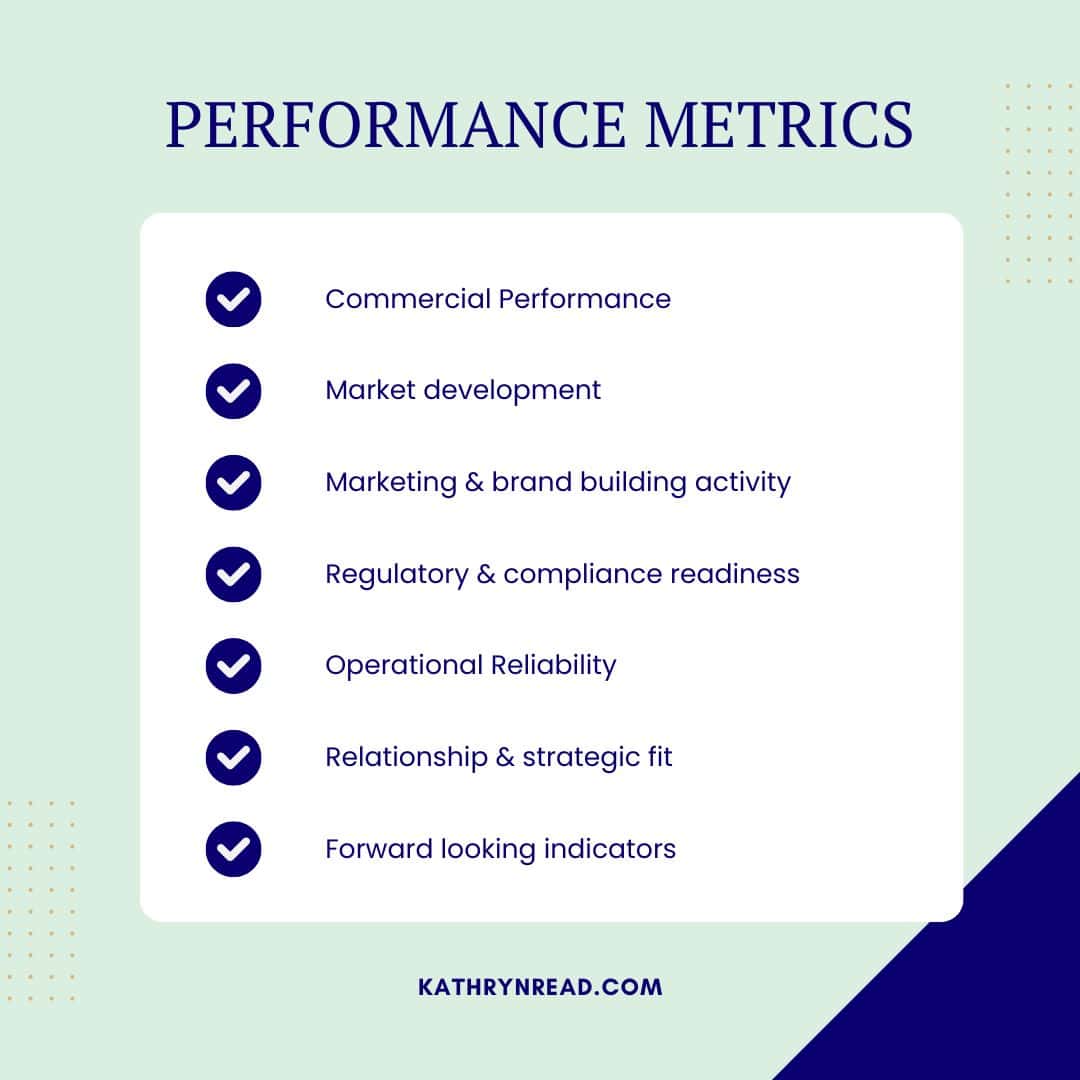
Areas of performance to analyse
The moral dilemma
This is where the real dilemmas begin. That person in Bulgaria who was always so supportive when you were struggling in the early days, who went through thick and thin with you, who you’ve spent countless hours in restaurants and bars with, isn’t “just a business partner”. They’re probably something closer to a friend — and that makes the decision a lot harder (than if you’d always disliked them anyway!).
The question becomes: how do you dissolve the business partnership and move on, without damaging your brand – and ideally without the ex-partner bad-mouthing you at every industry event for the next 10 years?
This hit me again the other night when I was rereading Itamar Marani • Performance Coach‘s book “Elite Performance”. The paragraph I highlighted was:
…that employee with a great attitude who helped you in the early days but can’t handle what the role now requires, or that original hero product that your old customers love but doesn’t help your business grow. These anchors are tricky because they come wrapped in loyalty and obligation, making you feel guilty for even thinking about cutting them loose. And that’s exactly what makes them dangerous.
Itamar Marani
I found myself nodding and thinking how this is exactly like dealing with distributors. Looking back at a few I’ve had to let go over the years, I can clearly see the pattern Marani calls “performance anchors”: they’re draining the energy you need to win.
Staying with a distribution partner who no longer fits creates unnecessary drag and mental load in your business, however much you enjoy the dinners and long conversations on the road. Loyalty can blind you to the numbers: missed targets, uneven sell-out, or inconsistent execution may all be visible through careful distributor performance tracking and regular distributor performance reviews.
If you’ve invested time and energy (and money) coaching that distributor on best practices and growing your brand, but it’s obvious that despite any improvements they’ll never reach the standards you expect, then it’s time for a change. Evaluating them through clear distributor performance metrics and structured evaluating distributor performance sessions can make this difficult decision far less subjective. (If you finally decide you need a change, then you can find my guide on How to Terminate a Distributor here)
Once you’ve acknowledged the conflict between the numbers and your sense of loyalty, the question becomes: what are you actually going to do about it? Avoiding a decision rarely helps; instead, the situation tends to drag on, eroding results and damaging the brand’s long-term prospects. Moving forward requires clarity, structure, and a plan that balances commercial logic with basic fairness.
How to move forward?
There are two main steps here … which makes it sound deceptively simple, when in reality it’s anything but.
1. Clarify your legal situation first.
Before you even whisper to a potential replacement, make sure you understand what your contract allows AND what the national laws in that market might dictate. In an ideal situation, you’ll have clarified how executable (is that a proper word?) your contract is in the territory prior to having signed anything, but life isn’t always that tidy. Some territories, like Lebanon or parts of Southeast Asia, offer strong protections to local distributors and ignoring these rules can create months (or even years) of unnecessary legal headaches.
2. Start a stealth search for a replacement.
Ideally, this begins quietly, especially if you don’t yet have a new partner lined up. The reality is that in smaller markets, news spreads quickly. Keeping the search discreet protects both your business and your brand reputation, but always cover your legal bases first. You may find that if your brand is poorly represented, that other distributors will start to reach out to you asking for the contract. Be careful to do proper due diligence in such cases – they may be great potential partners for you, but you have no guarantee (& they might have reached out because they see your partner is doing a great job and they’d like a piece of the pie so make sure you take all factors into account before jumping to any conclusions).
While these steps seem straightforward, there’s a long list of practical considerations you must factor in to avoid losing momentum:
Product registrations and trademarks: Ideally, these are in your name (or a legal proxy’s), not the distributor’s. If not, plan for transfers early. Some markets only allow one company to be registered as the official importer of a product so calculating all the timings of this to avoid out of stocks on the market is tricky.
Stock management: Taking over existing inventory from the previous partner’s warehouse is usually messy, and can temporarily disrupt sales flow. Chances are that if your previous partner wasn’t doing a great job, that their stock management also won’t be the best either…
Financial obligations: Retailers and other partners may have claims under existing contracts that need settling.
Returns and trade issues: Expect challenges in processing returns or managing service obligations previously handled by the outgoing distributor. The minute that you communicate to your outgoing partner that you wish to terminate the contract, you should reckon with them doing crazy things in the market to create problems. Of course, not everyone does, but it’s best to plan for the worst-case scenario
Brand-building continuity: Marketing, trade promotions, and launch activity often stall during a transition. If not carefully managed, you could see a 6–12 month drag in sales before the new partner finds their rhythm.
Even with a well-managed transition, these challenges are real. The outgoing partner may react emotionally by ceasing deliveries, withholding information, or criticising your brand in-market. As we all learned in school: hurt people hurt people.
The ideal scenario is a smooth handover, but realistically, planning for the worst-case scenario ensures you don’t lose more than you have to. Here, structured distributor performance tracking and detailed distributor performance metrics can make the difference between a shaky handover and a controlled transition.
CHECKLIST– HOW TO TERMINATE A DISTRIBUTOR Preparation: Distributor Performance Assessment Review 12–24 months of distributor performance. Document the gaps between expectation and delivery. Confirm internally that the change is strategically justified. Secure alignment with all internal stakeholders, especially finance and regulatory.
Execution: Begin the structured exit Hold a formal review with the current partner and present the data neutrally. Allow space for correction, but set clear, time-bound expectations. If the situation is beyond repair, communicate the termination professionally, with notice period specifics and final order arrangements clearly documented.
Transition: Manage the handover deliberately Ensure orderly transfer of registrations, retailer contracts, and price lists. Coordinate destocking and relaunch timing to avoid gaps on shelf. Brief the new partner thoroughly, with realistic expectations and milestones. Over-communicate during the first 90 days: silence is what kills momentum fastest.
Navigating the Risks Without Losing Momentum
Changing a distributor is never painless, and even when executed well, it often costs 6–12 months of delayed growth. This is why your decisions need to be data-driven as much as gut-driven. Look at your distributor performance review results, examine the metrics over the past 6–12 months, and use that insight to identify patterns that justify a switch.
Why the 6–12 Month Drag Happens
A partner change is never a quick swap-and-go. Even if you’ve found the perfect replacement, the transition window almost always lasts six to twelve months. And no, it’s not because anyone’s being slow – it’s because the mechanics of the market simply take time:
• Old stock must be cleared or run down The outgoing partner rarely wants to hold a gram of inventory for longer than necessary. Some will even oversell to finish stock early, which can break your price architecture & flood the market with products that retail struggles to move before the end of the shelf life.
• Retailers need to process new contracts Listing changes aren’t instant. Supermarkets and pharmacies batch updates, and sometimes you’re simply stuck waiting for the next reset cycle. (There may only be 1 or 2 per year…)
• The new distributor is cautious at first No one wants to over-commit on their first order. They’ll start measured, gather real sell-out signals, then scale. This might be sensible but slow momentum can test your patience especially if you’re under pressure from your top management.
• The sales team needs time to learn the product Even if your brand is simple, nobody sells confidently on Day 1. Training, sampling, objection-handling… those all take time.
• Promotions and visibility slots are planned months in advance If your distribution partner swap happens in Q2, don’t expect strong promotional rotations until Q3 or even Q4.
This is exactly why the decision to change partners must be made early — not at the point of firefighting.
Key considerations when evaluating a potential replacement:
When an existing partner isn’t performing, it’s easy to fall for the first distributor who promises rapid results. This is exactly when rigorous due diligence matters most. At minimum, verify:
Category focus: Do they genuinely know your aisle, or are you just rounding out their portfolio?
Share of mind: Which brands will they prioritise ahead of you?
Sales team capability: Who will actually sell your brand, and what’s their retailer access?
Management alignment: Does the owner understand your ambitions and growth model?
Operational reliability: Lead times, warehouse conditions, and historical fill rates.
The aim is not to find a “perfect partner” but to find one whose commercial model and ambition align with your next stage of growth.
Are they capable of reaching the distributor performance metrics your brand now requires?
Can they handle the current market complexity and future growth targets?
How quickly can they activate trade promotions, forecast accurately, and maintain stock availability?
Do they have the gravitas and diplomatic skills to pour oil on the troubled waters that your previous partner is probably leaving behind?
Remember, evaluating distributor performance isn’t just a routine exercise but is the compass that tells you whether your next step will accelerate the brand or stall it.
Reputational risk management during the handover
Whenever a distributor transition occurs, rumours fly. Some outgoing partners will accept the decision gracefully. Others will attempt to shape the narrative. You cannot silence them, but you can stay ahead of the story.
Speak directly with key retailers before the transition is announced.
Provide a clear, calm explanation: “We are upgrading resources to meet category demand.”
Share a timeline that demonstrates continuity of supply.
Reinforce that prices, terms, and listings will remain stable.
Prepare your new partner to answer inevitable questions confidently and consistently.
If handled well, retailer confidence should improve rather than decline.
Ethical exit: managing the end of a partnership responsibly
Ending a distributor relationship is a business decision, but it carries ethical responsibilities especially if you are selling a product where consumers can’t easily replace you at the drop of a har. A fair process protects your reputation as much as your conscience.
Give clear, honest feedback to the present partner rather than vague statements.
Respect agreed notice periods.
Avoid sudden delistings that damage the outgoing partner’s cash flow unnecessarily.
Allow them to destock in a controlled way or simply agree to take over reasonable amounts of stock (this can be tricky in food as expiry dates have to be managed well, but you don’t want anything flooded into the market).
Keep communication factual, not emotional.
A clean exit sets the tone for your new partner and signals professionalism to the wider market.
Common mistakes to avoid – Announcing the change too early, before regulatory or retail documentation is secure. – Letting the outgoing partner run down stock without oversight, which creates damaging out-of-stocks or floods the market with potentially short-dated products. – Overestimating the new partner’s initial capabilities, leading to unrealistic sales targets. – Failing to maintain direct customer communication, which leaves room for rumours. – Assuming momentum will recover on its own – it won’t.
The TL;DR: Make the Hard Choice with Confidence to Bring the Distributor Performance Metrics Back on Track
At some point, loyalty becomes the very thing stopping your brand from reaching the next stage. Switching distributors isn’t heartless or a betrayal of your previous partner but an essential part of leadership when you put your brand first. The strongest brands are built by those who can make clear-eyed decisions, even when difficult emotions are involved.
Your responsibility is to the brand and its future, not to the distributor’s feelings about the past. If a partner has become a performance anchor, don’t wait for frustration to force a rushed exit. Run the assessment, check the legal framework, start the quiet search, and then move decisively.
Remember: a distribution partner is not a soulmate. You don’t owe them forever – however you DO owe the brand good stewardship. Yes, loyalty matters a lot, but not at the expense of momentum. If a partner can no longer support your next stage of growth, the kindest (and most commercially sensible) action is a clean decision and moving forward. Staying in a partnership that no longer serves the brand doesn’t make you loyal; it suffocates your growth.
Making the decision early (before the relationship becomes toxic or the market position erodes) is usually the difference between a smooth transition and a rescue mission. Distributor performance metrics can guide the timing, but you having the courage to act is what will ultimately protect the brand.
Thinking that working with a consultant would accelerate your international expansion?
If you’d like to learn more about working with me for support on your internationalisation projects or personal export knowledge, you can book a 30 minute international clarity call here.
If you haven’t already signed up for my free e-book about how to select which international market to enter next, you can do so here, or using the form below.
If you enjoyed this content please share it on social media or recommend it to your network.
Pin this post for later!
If you are interested in working with distribution partners in your export markets, you might find these posts also interesting:
Kathryn Read, MIEx (Grad), is an international sales and marketing consultant with over 30 years’ experience developing niche products in emerging markets. She helps small and medium companies to break through international barriers, creating successful entrepreneurs and a thriving global marketplace. Kathryn firmly believes that business is done between people, and therefore places her focus on building strong relationships that form a solid foundation for doing business. When she's not travelling around the world, Kathryn enjoys playing clarinet in her town's wind orchestra or sharing her love of the outdoors with her Scout group.