
When companies talk to me about China, they usually fall into one of two camps. Some are so worried about what might go wrong that they never get beyond the first meeting. Others shrug and assume it will all work out, the way it did in their other export markets. Neither group has a clear picture of the China market entry risks that actually cause damage, and in my experience those are rarely the ones people lie awake worrying about.
So for episode 37 of International Expansion Explained, I invited my friend Art Dicker to help me answer the question in our working title: what could possibly go wrong? Art has spent most of his career as a lawyer in Beijing and Shanghai, first in private practice and then as an in-house general counsel, and he now advises companies from his own firm in San Diego. I come at the same problems from the commercial side, as someone who has spent a long time building distributor partnerships across Asia. Between us, we cover both the contract and the handshake.
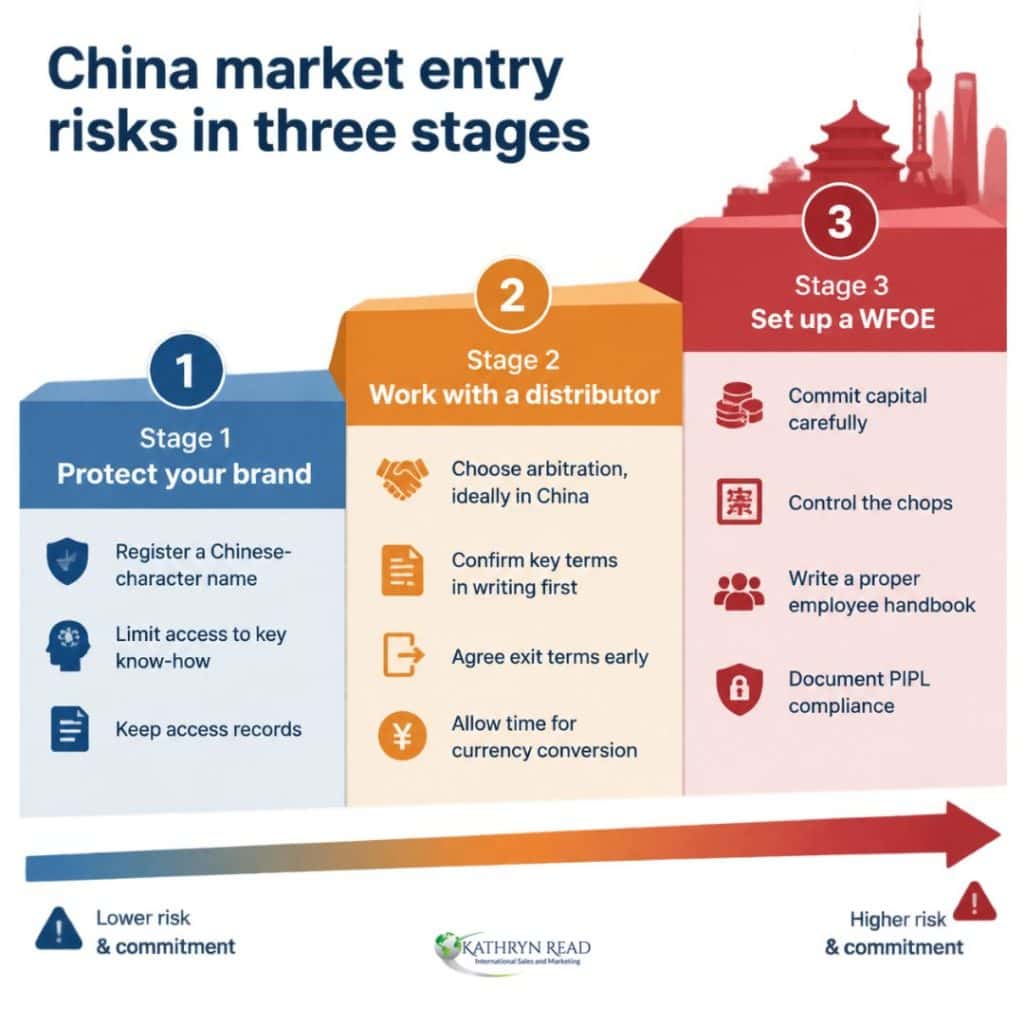
What follows is organised the way most companies actually (should) commit to China: first you protect your brand, then you work with a distributor, and only later (often at stage two or three) do you set up your own legal entity. The risks change at each step, and so does the cost of getting them wrong.
Table of Contents
Meet Art Dicker: a lawyer who learned Chinese before he learned the law

Art is the founder of Parkwyn Legal, a cross-border practice based in San Diego, California. He studied Chinese at college in the late 1990s, when talk of China joining the WTO made it clear the country would matter, and then went on to law school and a couple of years in practice in New York.
In 2007 he moved to the Beijing office of Morrison & Foerster, where he advised technology multinationals on venture capital and corporate matters in the run-up to the Beijing Olympics. In 2011 he went in-house as Asia-Pacific general counsel for Cadence Design Systems, the NASDAQ-listed chip design software company, a role that took him to Shanghai for six years. He then spent 3 years at PAcific Bridge Group prior to returning to private practice in Shanghai at R&P China Lawyers, before moving back to the US around 2023 and setting up Parkwyn.
Across around 16 years in China, Art has advised on M&A, venture capital, joint ventures, licensing and distribution deals, along with the everyday employment and IP questions that come with running a business there. Today his team of four Mandarin-speaking lawyers helps foreign companies doing business in China, and increasingly Chinese companies coming to the US. His own sweet spot is technology, particularly semiconductors and SaaS.
Paranoid or cavalier: where the real China market entry risks sit
Art’s starting point was the spectrum I described above. On one side are the people who are paranoid; on the other, those who deliberately keep their heads in the sand. As he put it, the truth is somewhere in between.
His first piece of advice sounds obvious, which is probably why so many companies skip it: go in step by step. Whether it’s the amount of capital you commit or the number of people you hire, both are much harder to undo in China than in most markets. Committing to either too early is one of the most expensive China market entry risks, simply because reversing it takes time, money and patience.
It’s also worth remembering how quickly the backdrop can shift. Art told a story from his time at Cadence: when he joined, few people outside the industry had heard of the company. By 2025, chip design software was so politically sensitive that the US imposed export restrictions on it late in May, cutting Cadence off from Chinese customers. The licensing requirement lasted fewer than six weeks before it was lifted again, but for those weeks a business built over decades was on hold.
That’s the reality of China today. Most of the risks covered below are within your control. A few aren’t, and your plan needs room for both.
Stage 1: protect your brand before you need it
Register your name in Chinese characters as well
China runs a first-to-file trademark system, which means the first person to register a mark owns it, whether or not they ever use it. Art described the classic horror story: someone spots your brand at a trade show, guesses you’ll be coming to China soon and registers it before you do. Most of these squatters simply want to be bought off. It has literally been a whole industry to sit on brand assets in this way, holding them effectively hostage.
The Latin-script version of your brand is only half the job when thinking about how to protect IP in China. If your name is hard to say in Chinese and you haven’t chosen a Chinese name yourself, consumers will make one up for you (that you may or may not like), and someone enterprising may register it. Art pointed to Michael Jordan, who was widely known in China as “Qiaodan” long before he did any marketing there. A Chinese sportswear company built a brand on that name, and Jordan spent years in the Chinese courts trying to get it back.
The lesson is simple: localise your name early, choose it deliberately and register it, before a trade show, distributor or consumer does it for you. Naming your brand is both an art and a science so don’t just got with the first best idea, talk with someone who knows what they’re doing (I can make recommendations here if you need support).
Treat IP protection as an access problem
This was the part of the conversation that surprised people most. When I talk to prospective clients, IP is usually the only China risk they’ve already thought about, and many believe that taking IP to China automatically means losing it.
Art’s view, which he admitted is slightly odd for a lawyer, is that people worry about IP too much. Courts in first-tier and many second-tier cities are, in his experience, professional and objective, and there are specialised IP courts. If you have the evidence, you’ll get a fair hearing.
That “if” is the catch. Gathering evidence of IP theft, the smoking gun, is the real challenge anywhere and especially in China. So the most effective protection Art has seen comes down to practical access controls:
- Bring in only what you need. Separate what has to be in China from what can stay at home.
- Limit access to the people who need it. One client kept sensitive machines locked away, with a trusted person managing a log of who clocked in and out and who used which machine.
- Assume that once it’s out, it’s out. Prevention will always be cheaper than proving infringement later.
I’d add one commercial reality check. Many companies overestimate how many true trade secrets they have. A lot of what feels proprietary is closer to general industry knowledge, and it’s worth being honest about which parts genuinely need protecting before you spend money protecting all of it. Also, please note that China isn’t the only “first to file” market so you should be checking your protection in other export markets as well.
Protecting your IP is one thing I think people worry too much about. It’s probably weird for a lawyer to say that.
Art Dicker
Takeaway: before you sign anything
- File your trademark in China in both Latin script and a Chinese-character name you’ve chosen yourself.
- Decide which know-how genuinely needs protecting, then restrict physical and digital access to it.
- Keep records of who accessed what. If you ever need evidence, you’ll need it from day one.
Stage 2: working with a distributor
For most of the companies I work with, China starts with a distribution partner, and their own entity comes later, if at all. This is where the contract questions come in, and where some of the most common China market entry risks hide in plain sight. Again here, there are many naysayers who believe that any contract in China is fated to end in the foreign company being screwed over by the “evil Chinese”, but realistically speaking, if that were the case nobody would ever do business there at all would they?
Your standard contract probably won’t travel when doing business in China
Many companies assume that the distributor agreement they use everywhere else will work in China: German or English law, disputes heard in Munich or London, job done.
Art described this as a risky assumption. Think about what happens if a China-only distributor breaches the contract. They can simply say: go ahead, sue me in Germany, I won’t turn up. You might then win a judgment, but you still have to get it enforced in China, where their assets are, and that’s where it gets complicated, (even more) expensive & long-winded. (This is a key point in any international contract by the way).
For US readers: the US and China have no treaty to recognise each other’s court judgments. Chinese courts have become more open to recognising foreign judgments in recent years. A 2022 Supreme People’s Court policy liberalised the reciprocity test, and courts in Wuhan, Shanghai, Ningbo and Guangzhou have enforced US judgments. It’s still slow, uncertain and dependent on the type of judgment, so treat it as a fallback at best.
Choose arbitration, and consider choosing China
Arbitration gives you a much clearer path. China is party to the New York Convention, so an arbitration award from almost any country can be authenticated and enforced through a Chinese court. It takes time and money, but the route exists.
Then came the advice that I think most exporters won’t expect. Art recommends choosing dispute resolution in China, ideally Shanghai. It feels like handing the other side home advantage, but you’ll need enforcement in China anyway, and a professional, international venue you’ve chosen is far better than letting your counterparty pick their own home city.
Art has also changed his own view on this. He used to favour going straight to the Shanghai courts, because there’s no second enforcement step. In the last couple of years, though, he’s seen growing backlogs, with courts that are fair but understaffed, so he now leans towards arbitration in China to get a hearing sooner. The arbitration route is also getting more attention: China’s amended Arbitration Law entered into force on 1 March 2026, and SHIAC grew its foreign-related caseload by 41% in 2024.
A partner who doesn’t comment on your contract is telling you something
One of Art’s sharpest observations was about the “perfect” contract: the beautiful template with disputes heard in Santa Clara County or Frankfurt, which the other side signs without a single comment.
That’s usually a bad sign. It suggests they haven’t read it, or don’t care because they know they’re effectively judgment-proof. A partner who negotiates is at least taking the terms seriously.
It’s also worth being realistic about why you have the contract at all. Litigation in China is expensive, mostly because of the time involved in collecting evidence, translating it and getting overseas documents authenticated. For a dispute worth USD 50,000 or 100,000, Art’s advice was blunt: don’t bother. Even for larger contracts, almost every dispute ends in negotiation. The contract earns its keep as the starting point for that negotiation, whether or not it ever reaches a court.
Put the key terms in a plain-language email first
This is where Art’s legal view and my commercial one meet completely. Between the handshake and the 30-page contract, there’s a step most companies skip: writing down the key terms and asking the other side to confirm them.
An email or a one-page summary is enough, covering:
- payment terms
- delivery terms
- how orders are placed
- what each side is responsible for
From my side, the big advantage is language. If your partner is reading in their second or third language, plain commercial English is far easier to understand than formal legal drafting, and you’ll find out quickly if something has been misunderstood. From Art’s side, it removes a convenient excuse later. Nobody can claim they couldn’t be expected to read every line of a long English contract when they confirmed the key terms in writing.
I once spent 2 whole days of a hot summer in a windowless conference room discussing a contract and explaining in plain English with examples (that was then translated into Chinese) what every clause of a 40 page contract meant. The meeting minutes included bullet points of all the summarised points that were confirmed before the contract could be signed.
If the other party doesn’t even make any comments on your contract, that’s usually a bad sign.
Art Dicker
Talk about the ending while you’re still in the honeymoon period
Few people enjoy discussing how a partnership might end before it has properly started. In my experience, though, the early phase, when everyone is still going out for lunch and dinner and excited about the launch, is exactly the right time to have those conversations. Relationships are at their warmest, and nobody has anything to defend yet.
Art agreed, and added a useful filter. Talking about termination and disputes can feel uncomfortable in Chinese business culture, but a sophisticated Chinese company that’s used to global business should have adapted to it. If a partner presented as experienced reacts badly, that tells you they may be less international than you thought.
That beginning, that honeymoon period, when you’re still going out for lunch and dinner and everything’s going forward, is exactly the time when you can talk about those difficult things.
Kathryn Read
Allow for the RMB in your payment terms
The renminbi isn’t freely convertible, and Art thinks people underestimate the havoc that causes. Before your distributor can pay you, their bank will want to see the contract, usually with at least a reference Chinese translation, to confirm it’s a genuine commercial transaction. If they don’t already hold foreign currency, that takes time.
Build that lead time into your payment terms, and make sure a Chinese version of the contract exists, even if the English version is the one that governs.
Takeaway: working with a distributor
- Swap foreign court jurisdiction for arbitration, and consider seating it in Shanghai (with English as the agreed language).
- Treat a counterparty who signs without comment as a warning sign.
- Confirm key terms in a plain-language email before the full contract.
- Raise exit and dispute terms early, while the relationship is at its best.
- Allow time for currency conversion, and prepare a Chinese version of the contract for the bank.
Stage 3: when you set up a WFOE
For many mid-sized companies, a wholly foreign-owned enterprise (WFOE) comes later, once sales justify it. When it does, the stakes rise, because more of your money and more of your people are now inside China.
Registered capital goes in easily and comes out slowly
China has a concept of registered capital: the amount you commit to put into the company. In the past, enforcement of whether you actually paid it in was relaxed. That has changed. Under the revised Company Law, shareholders of a limited liability company must pay their subscribed capital in full within five years of establishment.
Once the capital is in, it’s very hard to get out. Art has seen more companies winding down operations recently and discovering exactly how difficult that is. His advice: be careful how much you commit, and don’t take “don’t worry about that” at face value from anyone setting up your entity.
If you already have a WFOE, check your articles of association now. Foreign-invested companies registered on or before 30 June 2024 have until 30 June 2027 to align their capital contribution schedules with the revised Company Law.
Whoever holds the chop runs the company
Art named this as the most overlooked risk of all. In China, a company’s official seal, or chop, can execute a contract on its own. Nobody needs to sign; the chop itself is legally binding. You also need it to change key company documents, including who the legal representative is.
The extreme example is ARM China, where a CEO who was being removed reportedly kept the company chop locked in his own safe and refused to leave. Without the chop, the parent company was stuck in bureaucratic no man’s land.
Art’s recommendations:
- Decide deliberately who has access to the chops, and keep a record of when they’re used.
- Consider a third-party provider that stores the chops and releases them only on your instructions.
- Separate bank account access in the same way, so no single person controls both.
I would also add that it’s worth checking the log of how the chop has been used every so often, just so the team are clear that you understand the importance of it. If you have set up the company so that certain decisions need the stamp of a person who is based in Europe or the US then you also need to think about the practicality of getting decisions made in a timely manner. I occasionally used to cart a chop to and fro in the past on my monthly visits…
Hire carefully, because letting people go is hard
Since the Labour Contract Law of 2008, Chinese employment law has followed a broadly European model. You need one of a limited set of legal reasons to terminate someone, and neither redundancy nor poor performance works as simply as many managers expect. Underperformance needs written warnings, training opportunities and documentation.
For US readers: this is the biggest adjustment for American companies. China has nothing like at-will employment. European exporters will find it more familiar, particularly anyone who has employed staff in Central and Eastern Europe.
Two practical points from Art stood out. The first is that polite performance reviews come back to bite you. If someone is performing badly but you rate them “needs improvement” to help them save face, you’ll struggle to argue later that they were a poor performer.
The second is the employee handbook, which Art called HR’s best friend. If the handbook doesn’t say working hours are 9 to 5, it’s hard to discipline someone who always arrives at 10. If it doesn’t say staff must ask before taking a day off, you can’t easily insist on it. Templates exist and need relatively little adaptation, so there’s no excuse for skipping it – anyone who helps you set up your WOFE or who has acted as your employer of record perhaps in the past should be able to help with this.
The handbook also needs to match reality. I’ve seen Chinese staff get anxious when a handbook sets a modest hotel budget for trips to lower-tier cities, and then they find themselves travelling with a company owner who wants an international five-star hotel at 10x the budget stated in the handbook. It’s easily solved with a conversation, but it’s much better to anticipate those situations in the rules.
Look beyond the general manager and the finance manager
Art described a pattern he has seen many times: a local general manager with a very tight grip on the team and on the flow of information. Head office visits, meets the GM, the finance manager and perhaps HR, and leaves reassured. Problems only surface when that GM leaves or someone has an axe to grind.
A related blind spot is suppliers. It’s more common in China for someone in procurement to have a relationship with a vendor, sometimes a family member, so it’s worth getting visibility of who your local entity buys from and how prices are negotiated. These issues stay below the surface until something else goes wrong, and then everything comes up at once.
I see a version of this across Asia, and in my experience it’s often worst in Singapore and Hong Kong. Excellent English and a UK, Australian or US education can make a team seem as if it shares head office’s mentality, when the underlying culture is still Asian, including a reluctance to raise bad news that would cost someone face. Art summed it up perfectly: there is no correlation between someone’s level of English and their trustworthiness, or their intelligence.
Take PIPL seriously, even where the rules are vague
China’s Personal Information Protection Law (PIPL) was modelled on the EU’s GDPR, so European companies will recognise the concepts. Art’s long-standing advice is that the rules are still being worked out in practice, so what matters is a genuine, documented effort to comply.
That good-faith effort matters more than ever, because enforcement has tightened since we recorded. Mandatory personal information compliance audits took effect on 1 May 2025, and in May 2025 the Shanghai cyberspace regulator penalised the local affiliate of a luxury brand for transferring users’ personal data to global headquarters without completing a cross-border compliance mechanism. For consumer brands sharing customer data with head office, that example should get attention.
For US readers: the US has no federal equivalent of GDPR or PIPL, only a growing patchwork of state laws such as California’s. Expect a steeper learning curve than your European competitors.
Takeaway: when you set up a WFOE
- Commit only the registered capital you’re confident you’ll need.
- Control chop and bank access through deliberate, documented procedures.
- Write honest performance reviews and keep your employee handbook up to date.
- Meet more of your team than the GM and finance manager, and review key suppliers.
- Document your PIPL compliance, especially any transfer of customer data abroad.
Cautiously realistic: China is open for business
After nearly an hour of talking about what can go wrong, Art finished on a point I wholeheartedly agree with: China is still a good place to do business.
Many Chinese rules are deliberately vague, especially in fast-moving areas such as technology. Art gave the example of ICP licences for hosting businesses online, where companies hear rumours that they’ll be shut down overnight. In his experience, authorities in grey areas usually give you a chance to fix the problem first, particularly if you can show you took advice, assessed the risk and acted on it. China still wants foreign investment, and arguably needs it right now.
The risks are real enough, but the China market entry risks worth losing sleep over are mostly the dull, avoidable ones: an unregistered Chinese name, an unenforceable jurisdiction clause, an unsupervised chop, a missing handbook. Each costs relatively little to fix early and a great deal to fix late.
The cheapest China risk to fix is the one you deal with before you sign
My own China journey started in 2008, in the aftermath of the melamine scandal, when I was working in infant formula. Since then I’ve seen companies succeed and stumble there, and the difference has rarely come down to luck. The companies that do well take common-sense advice early, match their commitment to their results and choose partners who are happy to talk about the difficult things.
Looking back at your own China plans, or at companies you’ve watched go into the market, which of these China market entry risks has caused the most damage, and could it have been spotted earlier? I’d love to hear your experience in the comments.
If you’re planning to enter China, or rethinking how you work with your current partner there, book a 30-minute clarity call (https://kathrynread.com/international-clarity) and we’ll stress-test your plan together, from choosing a distributor to deciding when, or whether, you need your own entity.
Please note: this article shares general insights from a conversation and isn’t legal advice. Art is a lawyer, but nothing here should replace advice specific to your own situation. Always consult a qualified lawyer before making decisions about contracts, entities or disputes in China.
Full interview
Watch my full conversation with Art Dicker, recorded live on LinkedIn in July 2025, as episode 37 of International Expansion Explained:
If you need legal support for doing business in China, or for bringing a Chinese business to the US, you can connect with Art on LinkedIn or through Parkwyn Legal.

Kathryn firmly believes that business is done between people, and therefore places her focus on building strong relationships that form a solid foundation for doing business.
When she's not travelling around the world, Kathryn enjoys playing clarinet in her town's wind orchestra or sharing her love of the outdoors with her Scout group.


