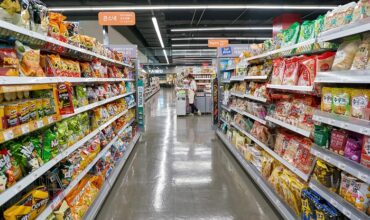
It was the middle of a Thursday afternoon in Shenzhen and the Kinglomo store was heaving. People were sampling at the fresh counters, filling baskets and queuing to pay, on a working day, in a mall. If you are a European brand thinking about selling snacks in China, this store deserves your attention, because almost nothing on its shelves came from a brand like yours.
I went in as a tourist and came out with a can of wampee tea with mango, a bag of salted almond toffee, some dried mango and a fairly uncomfortable conclusion for anyone exporting packaged snacks to China.
Table of Contents
What Kinglomo actually is
Kinglomo (金粒门, Jinlimen) started in Changsha as a roasted chestnut chain and repositioned itself as a “fresh snack” store in 2021. Its promise is short shelf life, made fresh, healthy. Industry press credits it as one of the founders of the fresh snack category in China.
Around 99% of what it sells is own brand, and most of that is developed exclusively for its stores. In Shenzhen even the drinks fridge was own brand.
It is still a young chain, with 20-plus stores in cities including Changsha, Wuhan, Hengyang, Shenzhen and Nanjing. Its rivals are growing fast too: Jiduoquan, backed by an established supply chain and a franchise model, has already passed 200 stores. Fresh snack shops are fast becoming a standard feature of Chinese shopping malls.
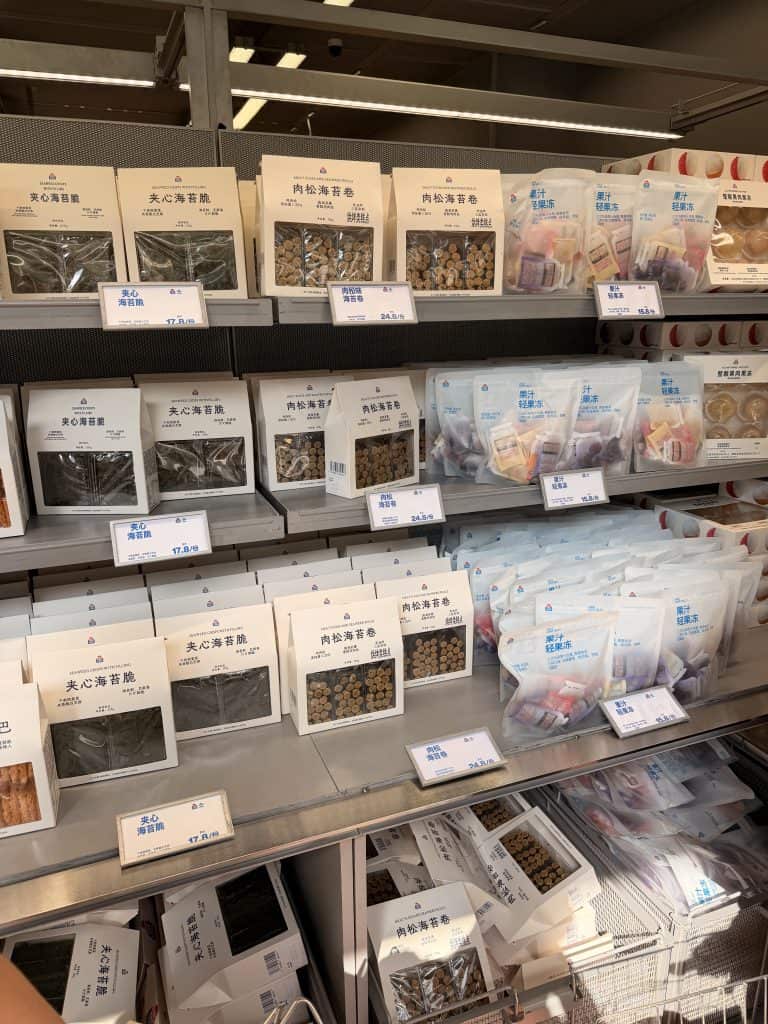
Photo: Kathryn Read
Two snack stores, one city, opposite answers
To understand why Kinglomo matters, compare it with another Changsha phenomenon. In April 2026 Busy Ming Group, the company behind Mingming Henmang, China’s largest snack retail chain, opened Snack Kingdom. At 12,000 square metres it holds a Guinness World Record as the largest snack store anywhere, with more than 35,000 products from 70 countries. About a third of all SKUs are imported. Two days after opening it had to suspend sales briefly because the crowds were unmanageable.
Kinglomo sits at the opposite end. Fresh snack chains typically run around 200 products, covering many categories with only a few lines in each. Short-life items such as braised snacks, bakery and freshly made drinks take up close to half the floor, because they bring shoppers back several times a week.
So Chinese snack retail is splitting into two models:
| Mass snack chains (e.g. Snack Kingdom, Mingming Henmang) | Fresh snack chains (e.g. Kinglomo) | |
|---|---|---|
| Range | Tens of thousands of products, many brands | Around 200 products, almost all own brand |
| Imported products | A meaningful share of the range | Close to none |
| How they win | Variety, discovery, low prices | Freshness, local flavour, repeat visits |
| What it means for importers | A listing is possible, but you compete on price and visibility | No shelf, and little realistic supply route |
Headroom per head remains large: Chinese consumers spend around a quarter of what Americans do on snacks, but overall growth has slowed to low single digits, so new formats like Kinglomo grow by taking share from someone else. The question for exporters is which of these two worlds their product belongs in.
Kinglomo is the sharp end of a much bigger shift in retail trends in China
Kinglomo is an extreme case, but the direction of travel is national. In August 2026 the China Chain Store & Franchise Association (CCFA) and Boston Consulting Group published their 2026 China private label report. It puts private label at around 8% of supermarket sales, and that figure excludes fresh food, so fresh snack stores like Kinglomo sit largely outside it. CCFA and BCG expect penetration to reach 20-30% by 2030 (that’s compared to core Western European markets at 40-50%, the Nordics and North America at 20-30%).
Demand is running well ahead of supply though. 40% of Chinese consumers say they are willing to buy private label, against that 8% sales share. In Europe and the US the gap is typically only 10-20 points. The categories the report flags as the next breakthrough are snacks, bakery, ready-to-eat food and non-alcoholic drinks, which is precisely Kinglomo’s territory. High-trust categories such as mother and baby, beauty and appliances are expected to move far more slowly (as they do in other markets globally too).
The figure that should worry European brands most is speed. According to the report, a new snack can go from concept to shelf in China in about two months. In Europe and the US the same process typically takes 10-18 months. Retailers are also explicit about the economics: in BCG’s beverage example, an own-label product sells at around 15% below the branded equivalent while the retailer’s margin rises.
Three things follow for European exporters:
- Shelf space for brands will become tighter and more selective. Retailers will keep brands that bring real differentiation, technology or cultural value, and squeeze the rest. A me-too imported snack will find life harder each year.
- Private label is a niche opportunity for European suppliers, defined by origin. For most products, European production costs plus freight and duty cannot compete with a Chinese factory. The exceptions are products where provenance is the selling point, such as Italian pasta, German ham or French cheese. Here the data is encouraging: half of Chinese private label buyers look for premium features such as imported products and regional specialities, and 40% of the retailers surveyed already use origin-based direct sourcing for their own ranges.
- Speed has become a competitive weapon. If a local competitor can launch a new flavour in two months, a 12-month development cycle in Europe leaves you permanently a step behind. Agree how China-specific SKUs get approved before you need them.
A word of caution: the 2030 forecast comes from a retail association and a consultancy, both with an interest in the trend, and Chinese retail tends to move in bursts. Even half that growth would reshape the shelves your products compete on though and realistically the speed question will always remain whether you wish to compete in the private label or branded space. How can you as a European or American manufacturer innovate faster without compromising on quality?
Familiar formats, Chinese flavours
What struck me most was how the range is built. It runs on two tiers.
- Formats any European would recognise. Crisps, dried fruit, bakery, toffee. Walk past and you could be in a modern deli in Vienna or London. Look closer and the flavours are firmly Chinese: meat floss and seaweed rolls, wampee (a small citrus-family fruit from southern China) paired with mango in a canned tea.
- Regional staples. Duck tongues, Wuhan-style spicy duck necks and similar snacks that a Western shopper would struggle to name. These anchor the store as Chinese and give regulars a reason to come back. My husband sadly was unwilling to try duck tongues even though I’m rather partial to them, but I’m honestly not sure how I’d have battled my way to the front of that chiller to pull out a pack!
Prices sit at the level of mid-range local packaged snacks. A 500g pack of meat floss and seaweed rolls cost 24.8 RMB, roughly €3. That is everyday money, which explains the crowd on a weekday afternoon.
Why this changes the game for selling snacks in China
Crisps, dried fruit and bakery are exactly the categories many exporters bring to China. Kinglomo sells them fresher, in flavours local shoppers prefer, at prices an importer cannot match once duty, freight, importer margin and distributor margin are added.
That makes Kinglomo a direct competitor for European snack brands. It also chips away at an assumption I still hear in boardrooms: that “imported from Europe” is enough to carry a snack in China. When a local chain has taken the format, adapted the flavour and made it fresh, the import label has to work much harder.
The freshness point matters more than many exporters realise. A packaged snack with a 12-month ambient shelf life sits on the wrong side of Kinglomo’s entire story. Anyone serious about selling snacks in China needs to know where their product sits on that freshness spectrum before choosing a channel.
If you’ve not sold into Chinese (or other Asian retail formats) before, you may not realise that for ambient products with a longer shelf life, retailers will often remove the products from the shelf when the remaining shelf life is 4 or even 6 months. It’s not like in central Europe where products remain on shelf until their expiry date (I’m not saying you can’t find expired products in the whole of China, but I’ve never seen any and believe me I’ve looked in detail at literally thousands of shop shelves) and consumers habitually check dates on products far more than their European counterparts.
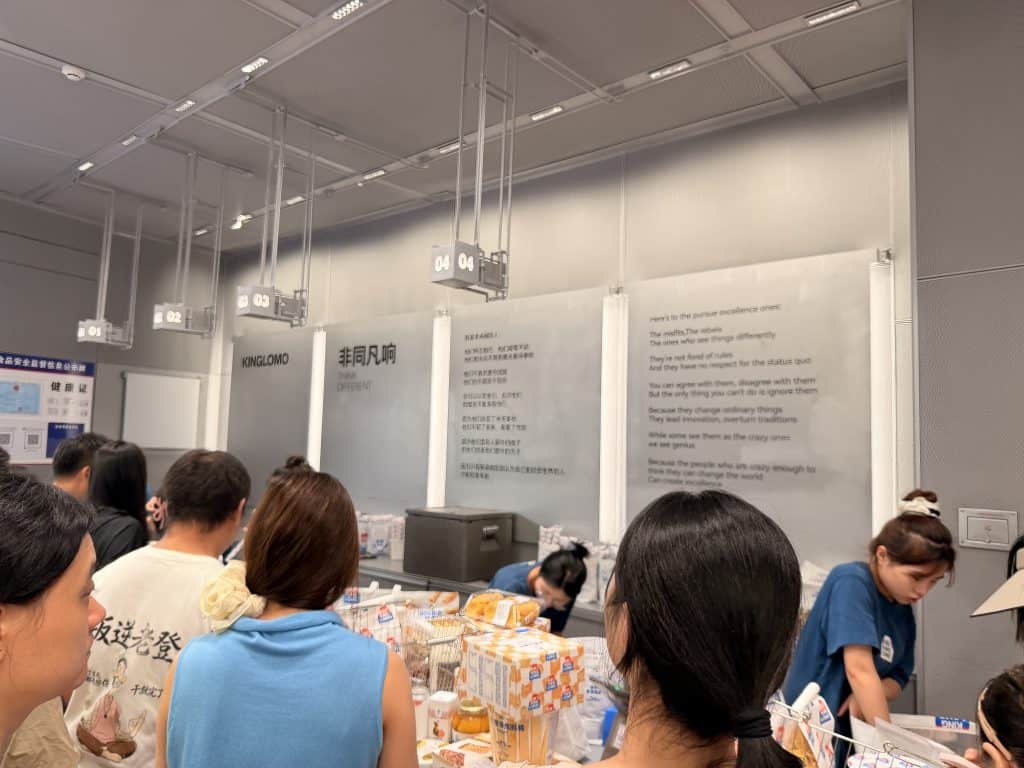
Photo: Kathryn Read
The format travels, the flavour has to localise if you target food retail trends in China
Many European brands launch in China with their home range unchanged, then wonder why rotation stalls after the first order. Kinglomo shows the other route: take a format people already like and rebuild the flavour around local taste.
In practice that means:
- Test flavours with your importer or distributor before the first shipment, and treat their feedback as market data.
- Budget for China-specific SKUs where the category allows it, even if volumes start small.
- Watch what fresh and private label players are selling in your category on Xiaohongshu and Douyin. They move faster than any brand and show you which flavours are winning.
- Check whether your recipe and pack size can be adapted within your existing production, so localisation does not become a separate project.
Where European brands still have an edge
There are still strong openings. They simply sit in different places from where many exporters are looking.
- Provenance and certification. Protected origin, organic certification and a credible farm-to-pack story are hard for a local fresh chain to claim. Lead with them if you have the chance.
- Gifting and premium occasions. Chinese New Year, Mid-Autumn Festival and corporate gifting reward attractive, long-life imported packs. Shelf life becomes an asset here for sales, not only logistics.
- Trust-sensitive categories. In areas such as infant and children’s snacks or functional nutrition, consumer trust in imported quality still carries real weight. The more “evidence” of your quality you have, the better
- The right channels. Cross-border e-commerce and premium import supermarkets reach shoppers who are actively looking for imported products, instead of asking them to choose you over a fresh local alternative.
- Origin-led private label. Kinglomo’s model depends on pushing upstream manufacturers to improve. For most European producers the price gap makes supplying Chinese private label unrealistic. Where origin is the product, such as Italian pasta, Tyrolean bacon or French cheese, retailers building premium own ranges can be a genuine route in. Chinese retailers increasingly frame this as joint R&D: the retailer brings consumer data and order certainty, the supplier brings raw material knowledge and reliable production.
Five questions to answer before you ship
Before committing budget to selling snacks in China, I would want a clear answer to each of these:
- Is my shelf life an asset or a liability in this channel? In gifting and cross-border e-commerce it helps. Against a fresh counter it hurts.
- Have Chinese consumers tasted this flavour, or only my team? Internal enthusiasm is not market research.
- What will my landed shelf price be against a local mid-range equivalent? Use a real benchmark, such as 24.8 RMB for 500g of meat floss and seaweed rolls. It doesn’t mean you have to match that, but you need to know where you play
- Which occasion am I selling to? Everyday snacking, gifting, children and health are different markets with different winners.
- Is my origin strong enough to sell under a retailer’s name? For provenance-led products, a premium own-label contract can be a faster route to volume than building a brand. For everything else, the numbers rarely work.
Compete where imports genuinely win
Kinglomo is a glimpse of where Chinese snack retail is heading: fresh, own brand, locally flavoured and priced for everyday purchases. For European companies selling snacks in China, the question is no longer whether imported packaged snacks will feel this competition. They already do.
The brands that succeed will choose their battleground deliberately. That means competing on what imports genuinely own: provenance, gifting and trust. Where origin is the product itself, supplying retailers’ premium own ranges can add volume. That is the realistic route to selling snacks in China for most European companies. Drifting into mass channels with an unchanged home range is the route I would avoid.
If your snack range had to sit next to a Kinglomo counter tomorrow, which of your products would hold their own on freshness, flavour and price?
Thinking that working with a consultant would accelerate your international expansion?
If you’d like to learn more about working with me for support on your internationalisation projects or personal export knowledge, you can book a 30 minute international clarity call here.
If you haven’t already signed up for my free e-book about how to select which international market to enter next, you can do so here, or using the form below.
If you enjoyed this content please share it on social media or recommend it to your network.
Pin this post for later!

Kathryn firmly believes that business is done between people, and therefore places her focus on building strong relationships that form a solid foundation for doing business.
When she's not travelling around the world, Kathryn enjoys playing clarinet in her town's wind orchestra or sharing her love of the outdoors with her Scout group.