
“We just need a good export sales manager.”
I must have heard some version of that sentence a hundred times over the last thirty years, usually from a company about to make an expensive hiring decision.
And I understand why.
A company decides it wants to grow internationally. Someone needs to sell the products. So the obvious answer is to hire an Export Sales Manager, International Sales Manager, Export Area Manager or International Business Development Manager.
Job title chosen. Job description written. CVs arrive.
Except there is a problem – there is no such thing as a generic “good” export manager.
There are people who can open a market from nothing, with no distributor, no track record and no local team to lean on. There are people who are excellent at managing an established distributor network for years, keeping forecasts honest, relationships intact and growth moving. There are people who are brilliant at direct key account management into international retail. And there are people who cut their teeth in export administration before ever interacting directly with a client, which, incidentally, is one of the most useful apprenticeships in the business and happens to be where I started.
Then there are all the hybrid formats in between.
Whatever you call the role on the organisation chart though, these are not simply variations on the same job. They’re different jobs that happen to share a job title.
And if you’re the person hiring for one of those roles, that distinction matters enormously.
Because hiring someone with ten years of “export experience” tells you very little until you understand what they were actually doing during those ten years.
Table of Contents
The structure has to exist before the person does
Before we even get to matching the right person to the right profile, there is a layer most companies skip entirely.
What does the market actually need from this person?
Has the market been validated at all, or is that still to be established? Are you creating a channel from scratch, developing a distributor relationship that exists on paper but not yet in practice, or managing a structure that is already delivering?
Is the problem actually sales?
Or is it that nobody has worked out the right route to market, the positioning is wrong, the distributor isn’t activated, the product doesn’t quite fit, or head office takes six weeks to approve anything?
What level of technical and marketing support will this person actually have?
How much decision-making authority do they carry, versus how much has to go back to head office for sign-off?
What budget do they control?
Who owns regulatory?
Who handles export administration?
Who manages supply problems?
Who creates marketing materials?
Who deals with credit control?
And, critically, how much time have you genuinely allowed before you expect to see results?
These aren’t HR questions. They’re commercial questions that the head of department needs to have an answer to in order to write the correct job description for the ad.
Companies that skip them can end up hiring a perfectly capable person for a role that was never properly defined in the first place, and then wondering why the new hire isn’t delivering.
A brilliant market-opener cannot compensate for a product that isn’t ready for the market.
A superb distributor manager cannot fix a distributor selection mistake.
A fantastic key account salesperson cannot magically create demand where the company hasn’t established product-market fit.
And an experienced export manager cannot make head office respond faster to every decision simply by being experienced.
What I’m saying here is that the hiring mistake often begins well before the candidate is even shortlisted. And before anyone comes for me, yes, I know that in most SMEs the role is going to be some kind of hybrid. I’m not suggesting you need four different people. However, what you do need is to understand which job is the primary one, because that determines what you should actually be looking for.
Export sales manager vs distributor manager: almost opposite skill sets
The two profiles companies confuse most often are the market-opener and the distributor manager.
Opening a new market from zero is, whether anyone admits it or not, partly a brand-building job. There is no local marketing team interpreting “think global, act local” for you. There may not even be a distributor yet.
You are deciding, often in a client meeting and in real time, what your brand actually means in that market. You are finding out whether the market opportunity is real. You are identifying potential routes to market. You are working out who matters. You are building relationships before there is necessarily any commercial reason for the other person to give you their time. You are experimenting. You are dealing with dead ends. You are trying to distinguish between genuine interest and someone who simply enjoys taking meetings with foreign suppliers. And yes it’s a lot…
It calls for persistence and curiosity, but also judgement. It’s entrepreneurial, often slow to show revenue and unforgiving of anyone who needs a well-defined structure to plug into.
Managing an established distributor network on the other hand calls for something quite different.
The brand exists locally already. The relationship exists. Customers exist. A sales history exists and there is a commercial structure to manage. The relationship is about trust and consistency as much as creation. The job is more stewardship though: protecting the partnership, keeping volume and forecasting discipline, developing the business and making sure both sides continue to see a reason to invest in it.
This is why I have never believed that the person who is best at opening markets is automatically the person who is best at managing them (although yes, many people are capable of doing both, they are mostly better at one or the other).
And it is why I have always been wary of the idea that someone who is “a really strong salesperson” from the domestic team must therefore be the right person to manage international distributors. When I built teams, I deliberately weighted them towards brand-building competence rather than hard sales technique for distributor management roles.
Hard sales skills have their place, particularly in direct key account management and some distributor negotiations (also if you accompany your distributors directly to retail), but they should not necessarily be the defining characteristic of the relationship.
I’ve watched companies load distributor management roles up with hard closers instead…..& it can really backfire.
You win a quarter but lose the goodwill of the partner. You push for the order instead of understanding why the partner isn’t selling. You negotiate every conversation as though it is a contest rather than recognising that brand owner and distributor ultimately need the same thing: a profitable business in that market.
Treating a market-opening stage and an established-distributor stage with the same playbook can quietly damage a relationship that took years to build.
And distributors remember being treated as a target to hit rather than a business to grow together.
It’s rarely two boxes. It’s a spectrum.
The market-opener/distributor-manager distinction doesn’t fully capture the reality, though.
There is a stage in between that is arguably the hardest of all where the distributor has been appointed. The agreement is signed and service levels are agreed. Everything looks right on paper and yet sales are still slow.
This isn’t unsupported market opening – but it isn’t really established market management either. It’s activation…Or monetisation…Or market development.
Whatever you call it, the job is to work out why the commercial model isn’t yet producing the expected result.
- Is the distributor selling to the wrong customers?
- Does the sales team understand the product?
- Is the pricing competitive?
- Is the product range appropriate?
- Is there enough marketing support?
- Is the distributor actually investing?
- Is the company expecting the distributor to do the work of a local brand owner without giving them the tools to do it?
- Is there simply not enough demand?
- Or is everyone looking at the wrong KPI?
This requires a different skill set again. The person needs to be able to diagnose rather than simply sell. They need to work collaboratively with a distributor, but also challenge them when necessary. That means they need to understand marketing as well as sales.
They need enough commercial experience to recognise when the problem is the distributor and when the problem is actually the brand owner’s own strategy, and they need enough patience to understand that “we appointed a distributor” and “we have built a business” are two very different milestones.
So, if I were reducing international sales roles to a simple spectrum, I’d think about them something like this:
BUILD → ACTIVATE → GROW → OPTIMISE
Build
There is little or nothing in the market. –> The job is to create opportunity.
Activate
The structure exists, but it isn’t working properly yet. –>The job is to diagnose, develop and make the model work.
Grow
The market is functioning. –> The job is to increase sales, distribution, profitability and market presence.
Optimise
The market is mature. –> The job is to improve performance, manage the portfolio, protect profitability and identify the next opportunities.
All four can sit under “Export Sales Manager” but they shouldn’t necessarily have the same job description and they certainly shouldn’t have exactly the same KPIs.
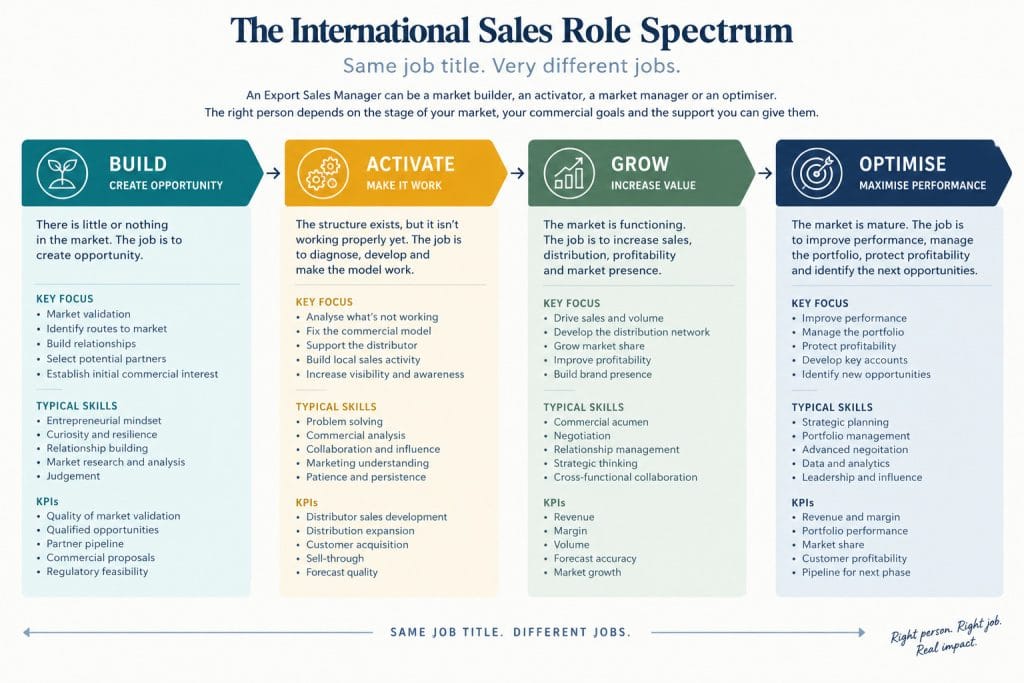
Your KPIs should match the job you’re hiring for
This is another place where companies create their own problems.
If you hire someone to build a market and give them an established-market sales target from month three, don’t be surprised if they start behaving as though their job is to chase orders at any price rather than build the market.
A market builder might initially need to be measured on things such as:
- quality of market validation
- qualified opportunities
- relevant customer and partner relationships
- distributor pipeline
- commercial proposals
- regulatory feasibility
- route-to-market development
- successful partner selection
Revenue obviously matters but it may take time before revenue becomes a meaningful measure of whether the person is doing a good job.
An activation role might have a different set of measures:
- distributor sales development
- distribution expansion
- customer acquisition
- sell-through
- sales team activation
- promotional execution
- forecast quality
- agreed commercial action plans
An established market manager can reasonably be held much more directly accountable for:
- revenue
- margin
- volume
- forecast accuracy
- distributor performance
- portfolio development
- market growth
- profitability
And a direct key account manager may have yet another set of measures around listings, distribution, account revenue, margins, promotional performance and customer profitability.
The point isn’t that there is one perfect KPI structure for each role. The point is that the KPI structure should follow the commercial job.
But if you don’t define the job first, you can’t define sensible KPIs…And if you can’t define sensible KPIs, how are you going to judge whether your new hire is succeeding?
Don’t recruit on market names. Recruit on responsibility.
This is one of the biggest mistakes I see when companies assess international sales candidates.
A CV says:
“Managed China, Korea and Southeast Asia.”
It sounds impressive, but what did “managed” actually mean?
- Did they own the P&L?
- Did they select the distributors?
- Did they negotiate the contracts?
- Did they set pricing?
- Did they develop the market strategy?
- Did they approve marketing plans?
- Did they deal directly with customers?
- Did they make regular market visits?
- Did they manage regulatory issues?
- Did they forecast?
- Did they deal with supply problems?
- Or did they receive orders from an existing distributor and pass them on to customer service?
- Those are completely different experiences.
The same applies to big-name customers. Anyone can put a famous international retailer on their CV without having had any meaningful influence over the relationship.
They may have been responsible for the account. Or they may have been one small part of a much larger team.
Even within the same company, responsibility can vary considerably depending on how the organisation is structured and how much autonomy the Head of Department gives an individual based on their experience or the sensitivity of the market.
Someone’s exposure to a market isn’t necessarily the same thing as their responsibility for it.
So when you’re interviewing, don’t just ask:
“Which markets have you managed?”
Ask:
“What did you personally own?”
Don’t just ask:
“Which kinds distributors have you worked with?”
Ask:
“How did you select them, and what did you do when performance wasn’t where it needed to be?”
Don’t just ask:
“Which major retailers have you sold to?”
Ask:
“What decisions were you responsible for in that account?”
The difference is enormous.
Contacts alone are not a competency
This is particularly relevant when recruiting for market-opening roles.
- “Strong network in Asia.”
- “Excellent contacts across Southeast Asia.”
- “Established distributor relationships.”
These phrases appear on CVs and job descriptions all the time, and contacts can certainly be useful. In fact, I use those phrases in my own work and LinkedIn profile.
But they aren’t a competency.
People change jobs.
Distributors change strategies.
Retailers change buyers.
Companies get acquired.
Categories evolve.
A contact who was extremely relevant five years ago may be completely irrelevant today.
And a network isn’t particularly useful if the person doesn’t know how to evaluate the opportunities it produces or how to build new relationships when things inevitably change.
I once compared a “total market value” figure, supplied by a well-known research company for one of my product categories, against my own sales and export data and discovered that according to the official numbers, my distributor and I had achieved roughly 300 per cent market share. (Wow, how good were we??)
The market size estimate was simply wrong and nobody else who had bought that study had thought to question it before.
I’ve heard near-identical stories from people doing this work across Southeast Asia, including one involving a well-known global fruit brand whose researched awareness figures for a market were, implausibly, lower than those of a much smaller competitor that only sold through premium retail there.
Nobody had queried it before the data reached the people making decisions on the back of it.
That is the kind of judgement companies are actually paying for. Knowing when the data in front of you doesn’t add up. Understanding what a payment term or Incoterm actually exposes you to, and what are the consequences of making changes to those. Recognising which regulatory detail changes everything & what the actual implications are for your business.
Understanding what the implications are of changing a distributor, pricing structure or route to market.
Knowing when a prospective partner is genuinely interested and when they simply like having another supplier presentation in their diary, or a certificate of distribution on their meeting room wall.
None of that shows up on LinkedIn next to a client logo.
International sales requires a tolerance for ambiguity
There is another quality I would look for much more deliberately when hiring international sales people: how comfortable are they when there isn’t a clear answer?
This is one of the things that separates international sales from many domestic sales roles.
A market opener might have:
- incomplete market data
- no established channel
- uncertain customer demand
- regulatory questions
- no local team
- unclear competitive information
- limited marketing support
- internal stakeholders who don’t agree with each other
The person has to make progress anyway.
An established distributor manager may have:
- historical sales data
- known customers
- an existing contract
- established logistics
- established pricing structures
- a functioning sales channel
- a local partner with market knowledge
Both people can legitimately describe themselves as export sales managers.
But they are operating in very different environments.
When I’m looking at someone who will be opening markets, I want to know whether they can make progress without having every piece of the puzzle handed to them.
That doesn’t mean being reckless.
It means knowing what you don’t know, finding out what matters, making a sensible decision with imperfect information and knowing when something needs to be escalated.
That’s very different from simply being “independent”.
Geography matters. But not in the way people sometimes think.
Another common hiring shortcut is:
“They’ve managed Asia before, so they’ll be fine.”
Maybe.
But “Asia” ,, like Europe or Africa, is not a market. Someone who did a fantastic job managing distributors in Eastern Europe may struggle to achieve the same results in East Asia.
That doesn’t necessarily mean they lack international sales ability.
It may be the interaction between their working style, the commercial environment, the distributor, the category, the stage of the market and the specific countries involved.
Some people love working in West Asia but feel like a fish out of water in East Asia. Others thrive in East Asia and struggle with the degree of autonomy required in less-developed markets. Some are brilliant at Western European key account management and discover that distributor development requires a completely different rhythm.
Many skilled international business development managers can succeed in a wide range of countries, but most will have environments in which they are particularly effective.
That is worth understanding when recruiting. Don’t simply ask whether someone has “Asia experience”. Ask what they actually did there, in which countries, at what stage of market development, through which channels and with what degree of responsibility.
Context matters.
The SME trap: hiring for perfect instead of generic
There is a variation on this mistake that I see constantly among smaller exporters, and arguably it is worse than hiring the generic “good” candidate.
It’s hiring for the perfect one.
Many SMEs, working with limited budget and headcount, want one person to be:
- the market opener,
- the distributor manager,
- the key account handler,
- the export administrator,
- the market analyst,
- the marketer,
- the regulatory expert,
- fluent in three local languages,
- happy to travel at least 50% of the time,
- comfortable presenting to the board,
- and somehow still available to chase the overdue invoice.
That person doesn’t exist….Or, if they do, you probably can’t afford them. It’s the German eierlegende Wollmilchsau, the mythical farmyard animal that lays eggs and gives wool, meat and milk all at once.

What follows is predictable.
The company hires someone who looks good on paper but is inevitably weak in some of the areas the role requires.
The person gets frustrated. The company gets frustrated. So then six or twelve months later, everyone decides they “weren’t the right fit”.
OK, sometimes they weren’t, but sometimes the role itself was the problem.
I’ve run workshops specifically on hiring international sales personnel because, in my experience, many of the people making these decisions, whether CEOs, Commercial Directors or HR, don’t have a hiring methodology that really fits international sales. They’re applying a domestic sales hiring process to a job that doesn’t work like domestic sales.
That is particularly dangerous because the breadth of the role can make a candidate appear more suitable than they actually are.
Someone who is very polished in interviews can sound as though they can do everything whereas someone who is less polished but has spent ten years solving messy international problems may not present quite as neatly.
That’s why the questions you ask matter.
What are you actually giving the person to work with?
There is another uncomfortable question hiring managers need to ask.
What are you actually giving this person to work with?
The point I’m making is “we’ll hire an experienced Export Manager and they’ll sort it out” is not a strategy. If the person is responsible for international market development, who is responsible for:
- Regulatory?
- Product adaptation?
- Marketing?
- Supply chain?
- Export documentation?
- Credit control?
- Customer service?
- Pricing approval?
- Contract approval?
- Local content?
- Budget?
- And how quickly can those people make decisions?
If the Export Manager identifies an opportunity in Korea but needs three internal approvals before they can even send a sample, that’s not necessarily a sales performance problem.
If the distributor asks for local marketing materials and the marketing department says it will get to them next quarter, don’t be surprised if the market doesn’t move.
If the salesperson identifies that the product range isn’t right for the market but has no authority to change it (or at least kick off that process), you haven’t actually given them the tools to solve the problem.
The best international salespeople can compensate for a lot but they can’t compensate for everything.
You can’t hire your way out of an organisational problem.
That is something I wish more companies understood before they start recruiting.
So what should the job description actually say?
Not:
“We are looking for an experienced Export Sales Manager to develop international markets and achieve ambitious sales targets.”
That could describe at least half of the export jobs on LinkedIn. Instead, start with the commercial reality.
For example:
“We already have distributors in five markets. Three are performing well, two have been appointed within the last twelve months and require activation. The person in this role will be responsible for developing those relationships, building the local sales pipeline and working with marketing to increase consumer awareness.”
That’s a job.
Or:
“We have established that there is a commercial opportunity in Southeast Asia but currently have no distribution structure. The person will be responsible for validating the opportunity, identifying potential routes to market, selecting suitable partners and establishing the first commercial relationships.”
That’s a completely different job.
Or:
“We have an established international business generating €10m annually. The role is responsible for a portfolio of existing distributors, with a focus on growth, profitability, forecasting and portfolio development.”
Again, different job.
Notice that the job title could still be exactly the same.
Export Sales Manager.
The title doesn’t tell you what the person actually needs to do. The job description should.
And then recruit against the job, not the title
Once you’ve defined the role, you can start asking whether a candidate’s experience is relevant.
Not just:
Have they sold internationally?
But:
Have they solved the kind of international sales problem we currently have?
That’s a much better question.
- If you need a market builder, look for evidence of building something.
- If you need an activator, look for evidence of diagnosing and turning around underperforming markets or partners.
- If you need a market manager, look for evidence of sustained distributor management and commercial growth.
- If you need a key account manager, look for evidence of direct customer ownership.
- And if you need more of a generalist for a hybrid role, be honest about which part is going to occupy most of their time.
Let me get this straight: there is nothing wrong with hiring a hybrid. Most of us in international sales are hybrids.
The problem is pretending that all the capabilities carry equal weight when they don’t.
The myth
The myth isn’t really that international business development managers are difficult to recruit.
It’s that “Export Sales Manager” is a sufficiently precise description of what you are recruiting for.
When it isn’t.
The person who opens a new market from nothing is doing a different job from the person who manages a €5m distributor relationship.
The person who activates an underperforming market is doing something different again.
The person selling directly to international retail has another skill set.
And the person who started in export administration may have developed a level of operational understanding that becomes extremely valuable later in their career.
There is no universally “good” export sales candidate. There is only a candidate who is, or isn’t, a good match for the commercial problem you need them to solve. So before you write the job description, don’t start with:
“Who should we hire?”
Start with:
“What do we actually need this person to do?”
- Define the stage of the market.
- Define the commercial problem.
- Define the responsibilities.
- Define the support structure.
- Define what success looks like.
- Define the timeframe.
- Then work out what kind of person can actually do that job.
Otherwise, you’re not really recruiting for an international sales role. You’re hoping that the right person will somehow emerge from a very vague job title, and that’s an expensive way to recruit.
If you’re hiring for international sales and you’re not sure what profile you actually need, that’s something I regularly help companies work through before they start recruiting.
Thinking that working with a consultant would accelerate your international expansion?
If you’d like to learn more about working with me for support on your internationalisation projects or personal export knowledge, you can book a 30 minute international clarity call here.
If you haven’t already signed up for my free e-book about how to select which international market to enter next, you can do so here, or using the form below.
If you enjoyed this content please share it on social media or recommend it to your network.
Pin this post for later!

Kathryn firmly believes that business is done between people, and therefore places her focus on building strong relationships that form a solid foundation for doing business.
When she's not travelling around the world, Kathryn enjoys playing clarinet in her town's wind orchestra or sharing her love of the outdoors with her Scout group.