
Almost every founder I talk to has a market in mind before they’ve done a scrap of research. Usually it’s the “obvious” one. Most UK brands default to the US. Many other English speaking markets default to the UK. Sometimes it’s simply wherever the founder fancies a business trip.
The problem with that though is that the obvious markets are usually obvious to your competitors too. You could be walking into the most crowded, expensive room in the building when a quieter one next door has better odds.
Deciding which international market to enter deserves the same rigour as any other big investment decision, because that’s exactly what it is. This is the Evaluate stage of my R.E.A.D. Method, and it’s where I see founders either save themselves years of wasted effort, or set themselves up for an expensive lesson.
Getting it wrong isn’t just a missed opportunity. It’s stock sitting in a warehouse you’re paying for with the shelf life running like the countdown on a ticking time bomb, a distributor relationship that never gets off the ground, marketing spend that lands with the wrong audience, and a founder team distracted from the markets that would actually have worked. I’ve watched food and beverage brands burn a year (or more) and a meaningful chunk of budget chasing a market that looked exciting on paper but was never going to be a fit. The research phase feels slow when you’re itching to get going, but it’s considerably cheaper than the alternative.
There are plenty of models out there for assessing market potential overseas, and the details vary, but most boil down to two questions asked in sequence: firstly how attractive is this market, and secondly can you actually execute in it? This post deals with the first question. Sizing the opportunity and assessing your ability to execute both deserve posts of their own, and I’ll cover those next.
I like to view the data through the perspective of a 2×2 matrix, using the metrics of “country attractiveness” and the “ability to execute” on the axes.
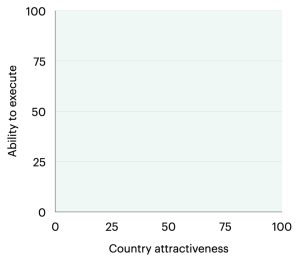
Table of Contents
Step 1: Build your long list of potential candidate markets
How do you begin populating your matrix? Like I mentioned above there are a number of theoretical market evaluation strategies but this is how I prefer to approach things. First, create a list of countries for consideration based on key variables that are relevant for your business. What are your must-have criteria and most important nice-to-haves, the things you’d like to have but could possibly compromise on? Choosing the right market entry evaluation criteria when deciding which international market to enter can really make or break your project.
For a food, beverage, or mum and baby brand, your must-haves might look like:
Market
- Existing consumer demand for products in your category (or a clear gap you can credibly fill)
- Local tastes or preferences
- Regulatory pathway that’s realistic for your product (labelling, ingredients, safety standards)
Macro
- Retail and distribution infrastructure that can actually get your product to shelf or to a doorstep
- Cold chain capability, if you need it
- stable (or growing) economy
- stable currency
Your nice-to-haves might include things like existing English-language capability in the trade, favourable import duties, or a growing middle class with rising discretionary spend on premium or imported goods.
Don’t be afraid to compromise on the nice-to-haves. That’s precisely what lets you widen the list to markets you might otherwise overlook, whether that’s Indonesia, the Philippines, or a smaller European market that’s less saturated than the obvious first choice.
It’s worth naming your channel preference at this stage too, even loosely. A brand that plans to work through distributors needs different things from a market than one planning to sell direct via e-commerce. If you already know you want a distributor relationship, put “credible, active distributors in this category” on your must-have list from day one. It will save you shortlisting markets that look attractive on paper but where you’d struggle to find the right partner (although maybe that’s a nice-to-have and you’d be ready to consider other business models to your regular channels if that increased your chances of success in a market that otherwise feels well suited?).
Don’t over-engineer this stage. The long list doesn’t need to be exhaustive, and it isn’t meant to be your final answer. Ten to fifteen candidate markets is more than enough to start scoring. You’re not trying to find the perfect market yet, you’re trying to stop yourself narrowing down too early based on a hunch.
Step 2: Score country attractiveness
Country attractiveness can be dened as a combination of the general country attributes and industry specific attributes. Once you’ve got your long list, rate each market against four categories:
Economy – GDP growth, inflation, exchange rate stability, currency convertibility, disposable income levels, skill and education levels
Culture – openness to foreign brands, compatibility with your positioning, acceptance of your preferred route to market (direct, distributor, e-commerce, DTC), local culture compatibility with your company values
Institutions – ease of doing business, import/export regulations specific to food and beverage or baby products, IP protection, trade agreements that might reduce duties, legal framework (can contracts be enforced)
Market access and infrastructure – retail landscape, e-commerce penetration, logistics and cold chain reliability, availability of credible distributors, banking structures
Score each market red, amber or green against each category. Green means this genuinely works in your favour, amber means workable but with real caveats, red means a serious obstacle you’d need to solve before entering. Be honest rather than optimistic. It’s tempting to wave a category through to amber because you like the market for other reasons, but that’s exactly the kind of gut-feel thinking this exercise exists to counter. (I’d say you need “brutal honesty” here, but unfortunately the phrase has been captured by AI models and seems to count as a “tell” these days…)
You can see that some of the factors influencing market selection that I’ve listed above are general (a stable legal and banking sector, GDP growth) whilst others are more specific to your brand (do you need cold-chain logistics) because I can’t give you a one size first all solution that is guaranteed to be right for your brand.
This isn’t about chasing a perfect score, and you’re highly unlikely to find one. Every market (same as every potential distributor) has some kind of trade-offs. The point is seeing them clearly on paper, side by side, rather than discovering them six months into a launch when you’ve already committed budget and reputation.
A few common mistakes with market evaluation strategies
Scoring on assumptions rather than research. “Everyone drinks tea in Country X” is not market research. If you can’t point to a source for a claim, treat it as unverified and go find the data before it influences your score.
Letting one green category carry the whole decision. A huge consumer base is exciting, but if institutions score red because import licensing for your product category is genuinely painful, that huge market might take years to become viable. Weigh the categories against each other, don’t let the most flattering one dominate. (China, India and the US are typical candidates for this)
Ignoring category-specific regulation. Food and beverage and mum and baby products carry very different regulatory weight to most consumer goods. Labelling requirements, permitted ingredients or additives, safety certification for baby products, and import licensing can vary hugely between markets that otherwise look similar on economic grounds. This is exactly the kind of thing that belongs in your institutions score, not something to deal with after you’ve already picked a market & exactly why deciding which international market to enter is such an important key to success.
Treating the matrix as a one-off exercise. Markets shift. New trade agreements get signed, regulations change, a competitor enters. Revisit your scoring at least annually, ideally as part of your regular planning cycle, rather than filing it away once you’ve made your first decision.
Scoring market access in the abstract, rather than against your actual channel. “Good retail infrastructure” means little if you haven’t decided whether you’re going direct or through a distributor. If distribution is your route in, score this category against the real question: are there distributors active in this category, with the reach and reputation you’d need, who might realistically take you on? That’s a very different question from whether supermarkets exist in a country, and whether they’ll be happy to work with you directly as a new to market foreign brand.
Retrofitting the results to fit the country you had in mind. I don’t think I need to go into this in detail. Export teams are often pressured to enter country x or y for subjective reasons rather than working through these steps for assessing market potential. Believe me, it ALWAYS comes back to bite you if you give in to that so if someone insists, get it in writing that it is their decision.
A worked example of using market entry evaluation criteria
Say you’re a beverage brand weighing up Indonesia, the Philippines, and a mid-sized European market.
Indonesia might score green on economy and market size, but amber on institutions if you’re unfamiliar with halal certification requirements or import licensing. The Philippines might score green on English-language ease of doing business and culture, but amber on logistics outside Metro Manila. Your European option might score green almost everywhere on ease of doing business, but red on differentiation if the category’s already crowded with local and imported competitors.

Laid out like this, the decision stops being “which country sounds most exciting” and becomes “which trade-offs am I actually willing to take on right now, with the resources I currently have.” Maybe that’s Indonesia, if you’ve got the patience and budget to work through halal certification & the regulatory process. Maybe it’s the Philippines, if getting to market relatively quickly with a distributor who understands your category matters more than a slightly slower institutional process. There’s no universally correct answer, only the one that’s right for where your business is today.
None of these is automatically the “right” answer. What the matrix gives you is clarity on exactly what you’re trading off, so the decision is deliberate rather than accidental.
A note on using AI tools as one of the first steps for assessing market potential overseas
There’s no shortage of AI tools now offering to do market evaluation for you, and I’d wager more will appear by the time this post is a year old. Used well, they can genuinely speed up the research phase, pulling together economic data or summarising regulatory frameworks far faster than you could manually. Additionally some of them offer access to databases and statistics that you’d not be able to access without a steeply expensive subscription.
Used badly, they’ll give you a confident-sounding answer built on criteria that have nothing to do with your actual business. This is the trap. An AI tool doesn’t know that cold chain reliability matters enormously to your chilled beverage brand but is irrelevant to a shelf-stable snack company. It doesn’t necessarily know that you’ve already ruled out markets without a credible distributor network, or that your product needs a specific import licence that most generic “market entry” prompts won’t think to ask about.
The output of such tools is only as good as your understanding of what actually matters for your brand, because that’s what shapes the prompt. If you don’t know your own must-haves and nice-to-haves going in, as covered in Step 1 above, you won’t know what to ask the tool to weigh, and you certainly won’t be able to judge whether its answer is credible or just plausible-sounding. Treat AI tools as a way to speed up the research within a framework you’ve already defined, not as a replacement for defining that framework in the first place.
The first part of deciding which international market to enter and what this doesn’t tell you yet
Country attractiveness is only half the picture. It tells you where the opportunity might be, not how big it is, and not whether you actually have the resources and capability to go after it.
Sizing the opportunity means putting a realistic figure on the market, and being honest about what percentage of it you can genuinely aspire to win, rather than working off vague enthusiasm about a “huge market.” Assessing your ability to execute means being honest about your product, your team, and your resources, because a market can score green across the board and still be the wrong choice if you don’t have the internal capacity to enter it properly right now. Those are the next two questions, and they deserve posts of their own.
For now, the job is simple: get your long list down on paper, score it honestly against these four categories, and resist the pull of “obvious.” The market that looks the most tempting on a map is rarely the one that makes you the most money, and the one that requires the most work upfront is sometimes exactly the one worth doing.
If you’d like a second pair of eyes on your shortlist, a 30-minute International Clarity Call is a good place to start.
Thinking that working with a consultant would accelerate your international expansion?
If you’d like to learn more about working with me for support on your internationalisation projects or personal export knowledge, you can book a 30 minute international clarity call here.
If you haven’t already signed up for my free e-book about how to select which international market to enter next, you can do so here, or using the form below.
If you enjoyed this content please share it on social media or recommend it to your network.
Pin this post for later!

Kathryn firmly believes that business is done between people, and therefore places her focus on building strong relationships that form a solid foundation for doing business.
When she's not travelling around the world, Kathryn enjoys playing clarinet in her town's wind orchestra or sharing her love of the outdoors with her Scout group.