
If you’ve been following the Asian beverage scene, you’ve probably noticed the rise of Chagee … and no, it’s not just a Chinese fad. In the past few years, this brand has scaled faster than most of its peers, and now it’s staring down the possibility of becoming a true global player. I’ve seen my fair share of beverage brands try and fail at international expansion, so trust me when I say: Chagee is doing a lot of things right… and a few things that will make any cautious consultant like me raise an eyebrow.
If I were sitting across from you with a cup of tea, I’d say: watch this story carefully. Not because Chagee is perfect (it certainly isn’t) but because it offers a masterclass in timing, branding, operational efficiency, and yes, what not to do when you take your cultural confidence abroad.
Table of Contents
Why Timing Made Chagee’s Success Almost Inevitable
First, let’s get one thing straight: Chagee didn’t win just because it has pretty stores and Instagram-worthy drinks. Timing was everything. The Chinese freshly made tea market was already massive, but the mid-market segment where most bubble tea brands competed was saturated. Price wars, closures, and stock competition were rampant – a classic red ocean.
This happens in many categories in China. A trend begins and many companies see the hope of making a fast win. So everyone piles in with huge discounts and in the end only a couple of players (who had enough cash to survive the discount cut-throat war) are left standing in the end.
In the case of tea though, the premium segment (= drinks priced at 17 RMB and above) was booming. In 2019, premium tea accounted for just 11% of the market. By 2023, that had jumped to 26%, and projections suggest it will hit nearly a third by 2028. That’s a projected $23.4 billion USD in sales for premium tea alone. In other words, the money wasn’t at the bottom of the price scale, but was consolidating at the top.
Young Chinese consumers, especially Gen Z and upwardly mobile millennials, were driving this growth. They wanted:
- Drinks that were healthier, lower in sugar, low-fat, and low-calorie (this has been such a massive post-pandemic trend that continues)
- A sense of cultural sophistication and modern identity that fits their sense of national pride
- Premium experiences that gave them something to post on social media (China’s youth are no different to the rest of the world in that aspect)
Chagee walked straight into that opening and hit a sweet spot where timing + insight + execution = a formula for explosive growth. And believe me, for any brand that I’m advising looking to enter China or Southeast Asia today, this is the first lesson: know where the value is, not just the volume.
Everyone sees the topline numbers of how huge the market can be in almost any segment, but many companies don’t want to recognise that it’s one thing to sell in China, but another to sell sustainably and profitably.
Product Strategy: Less Is More
One of the reasons Chagee scaled so quickly is deceptively simple: it kept its product range tight compared to the competitors. I cannot overstate this. In a market where competitors pile on 20–30 flavours hoping for a viral hit, Chagee did the opposite.
- 91% of its revenue by 2024 came from fresh milk tea (cha latte) made with whole tea leaves
- Three core products drove 61% of total revenue
- The Jasmine Green Milk Tea (伯牙绝弦) became a hero product – almost a cultural icon in its own right
If I were sitting next to you, I’d point out there’s genius in restraint. This is exactly how Starbucks built its empire: a few core drinks, occasional seasonal hits and relentless focus on operational excellence.
Chagee also benchmarked against premium coffee consumption (ie Starbucks) rather than bubble tea. Instead of trying to fight on the dessert beverage battlefield, it positioned tea as a daily ritual that you need for studying, for commuting, for office breaks, for socialising. You rarely see F&B brands moving from “treat” to “functional daily habit” – if anything they move in the other direction.
And this is relevant for international expansion too, because when you enter markets like the US or Europe, you’re not competing with bubble tea; you’re competing with coffee rituals, office habits, and people’s daily routines.
The Operational Machine Behind the Magic
You can’t hit over 6,600 stores globally by Q1 2025 without operational wizardry. Chagee built what I’d call a “premium fast-casual engine”:
- Asset-light franchise model: Over 90% of stores are franchised, but they’re tightly controlled. No free-for-all licenses.
- Strict site selection: Franchisees cannot just pick any old locations. Corporate vetting ensures foot traffic and prestige.
- Comprehensive SOPs (Standard operating procedures): covering sourcing, preparation and service levels
- Simplicity in ingredients: Tea + milk + syrup. No over-complication.
- Automated tea machines: Just eight seconds per cup, consistency guaranteed, with an extraction process similar to coffee.
- Inventory turnover: 5.3 days on average making things lean, agile & risk-minimised
The bit that most people miss though is that the low store closure rate compared to competitors (0.5% in 2023, 1.5% in 2024) isn’t luck, but results from the business model structure. Franchisees make money, customers get consistent quality, and the brand maintains integrity. If I were building a franchise-based beverage brand, this is exactly the kind of rigour I’d look to replicate.
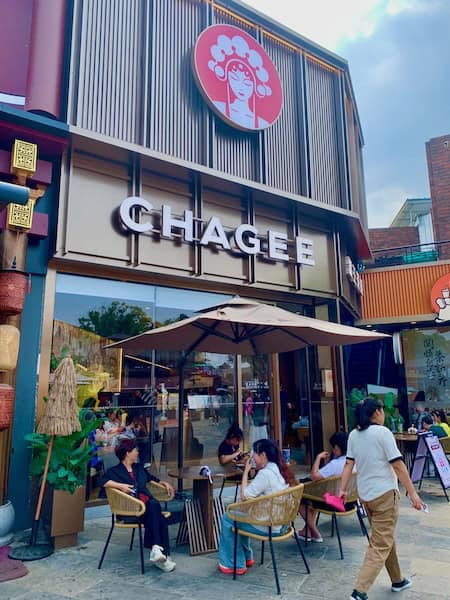
The brand experience is all about making tea a lifestyle
Product and operations are one thing. Branding and experience are another – and Chagee nailed both. Their stores are minimalist and elegant, blending traditional Chinese aesthetics with a modern twist. You see tea leaves being brewed, you feel the ritual, you take photos (and yes, it’s very TikTok/Xiaohongshu friendly). Not to be compared with the typical instant powder mass market bubble tea experience.
It’s not just about visuals though. The brand also created emotional hooks with tiered loyalty programmes, VIP perks and early access to seasonal drinks … all of which are designed to create repeat behaviour. Then you layer on seasonal limited editions that add scarcity, urgency and word-of-mouth buzz.
The O2O (Online to Offline) integration is pretty much a given these days, but there’s a difference between doing something, and ensuring a really smooth customer experience. The CHAGEE mobile app facilitates seamless digital engagement through pre-orders, real-time promotions, and reward tracking, connecting digital activity with physical store visits.
The cultural storytelling is where Chagee truly differentiates itself though. Collaborations with the Forbidden City Palace Museum and legacy figures like sports star Lee Chong Wei give credibility and aspirational weight to what could otherwise be just another milk tea chain.
If I were advising a brand looking to upscale in Asia on what they can learn from this, I’d say: products alone won’t carry you these days. Experience and storytelling do the heavy lifting.
CHAGEE’s strategy is like building a luxury train: it uses a highly standardized, efficient engine (the asset-light franchise model and 8-second tea preparation) to achieve phenomenal speed, while simultaneously decking out the carriages (stores and branding) in high-end, culturally resonant aesthetics to attract premium clientele and elevate the entire journey above the competition.
Health, culture, and novelty are key to understanding the consumer
We’ve talked strategy and operations, but we shouldn’t forget why Chagee’s customers actually care. In China, young consumers are driving the shift toward:
- Health-conscious drinks: Low sugar, relatively few calories, whole-leaf tea, fresh milk, zero trans fats.
- Premium lifestyle signals: The brand is aspirational. Buying Chagee is a statement that says, “I care about quality and taste, and I’m culturally sophisticated.”
- Novel consumption scenarios: From “tea instead of alcohol” at weddings and corporate events to limited-time seasonal beverages, Chagee constantly nudges consumer behaviour.
If successful, market analysts suggest that repositioning tea from a leisure beverage to a daily coffee alternative could unlock more than tenfold growth in user potential.
If I were advising you about a premium launch, I’d tell you to pay attention because Chagee isn’t just selling tea. It’s selling identity and emotional reward as well as new consumption opportunities. That’s why it resonated so quickly with urban millennials. What could that look like for your brand?
How does Chagee compare to the competition?
CHAGEE’s market approach is miles apart from the high-volume tactics of Mixue and Luckin Coffee and that’s absolutely intentional. What they’ve built is a textbook example of Customer Engagement Marketing (CEM) used not as a loyalty programme bolt-on, but as the backbone of the entire brand. If you’re trying to understand how premium pricing can survive a market obsessed with discounts, volume and burn-rate growth, this is the playbook to study.
Unlike Mixue and Luckin, CHAGEE isn’t trying to sell drinks – it’s selling belonging, it’s selling culture, it’s selling aspiration. And that’s exactly how they hold their price point in a sector where everyone else is racing to the bottom.
Here’s how that looks when you break it down.
Brand Positioning: Premium Lifestyle vs. Mass Market
CHAGEE has decided it will not be dragged into the bargain basement end of the tea and coffee market. It positions itself as an upscale tea experience & is very deliberately aligned with heritage, wellness, and cultural pride. Think: “What if Starbucks were born from Chinese tea culture instead of Seattle coffee culture?”
| Strategy Area | CHAGEE (Premium Tea) | Mixue (Mass Market/Low-End) | Luckin Coffee (Convenience/Value) |
|---|---|---|---|
| Primary Goal | Cultural sophistication, premium lifestyle, and emotional connection | Volume, affordability, and fun, targeting suburban and rural areas | Urban convenience, accessibility, and high-frequency transactions |
| Pricing Strategy | High Prices/Premium: Maintains high prices, even double or triple discounted drinks at other chains, refusing to fully engage in price wars. | Ultra-Low Cost: Built around US$1 ice cream and affordable drinks. | Value/Discounts: Focuses on subsidies and cheap online orders to undercut prices. |
| Product Focus | Health and Quality: Whole-leaf tea, fresh milk, zero trans fats, low-sugar, and low-calorie drinks. | Mass-market appeal (bubble tea, ice cream, coffee). | Coffee and tea hybrids, focused on speed and convenience. |
By emphasizing authenticity, craftsmanship, and health (such as using high-quality tea leaves from Yunnan and brewed tea rather than artificial powders) CHAGEE successfully differentiates itself in the premium segment and avoids the price competition that dominates the mass market where Mixue and Luckin operate.
CHAGEE doesn’t need to tell people they’re premium, because they make it visible in the ingredients, the brewing process, and the cultural narrative.
In-Store Ambiance and Customer Experience (Physical CEM)
The store isn’t just a shop but part of the product – CHAGEE really leans into that.
They’re designing their outlets to feel like a sanctuary with minimalist lines, traditional touches, calm colours, soft lighting, intentional seating. That’s not accidental. It’s a strategy to:
- Create a “third space” where people linger (and share on socials).
- Reinforce the emotional connection to culture and wellbeing.
- Convert “I bought a drink” into “I participated in something.”
And this becomes more obvious when you contrast with the competition:
- Mixue: everywhere, bubbly, bright, Snow King cartoon mascot leading the charge. It’s a place you run in for something cheap and cheerful.
- Luckin: compact, efficiency-first, takeaway-centric. You’re not meant to stay. It’s a refill station for work.
CHAGEE is the only one that says: Come in. Stay as long as you want. Feel the brand.
Scarcity, Loyalty, and Cultural Marketing (Digital and Product CEM)
Here’s where CHAGEE becomes really smart.
They’ve built their digital engagement not around price discounts (Luckin) or cheerful mass-appeal novelty (Mixue), but around prioritisation and exclusivity.
A few key tactics worth considering:
- Seasonal & limited-edition drinks. Not just flavour-of-the-month but culturally anchored, highly photogenic and fleeting. This fuels predictable demand spikes and FOMO.
- The tiered loyalty programme. It’s not about free drinks at the bottom tier. It’s about status at the top tiers with early access, special drops & VIP perks.
- Cultural and luxury-style collaborations. From the Palace Museum to Angel Chen to Zheng Qinwen – every partnership reinforces the brand message of modern Chinese lifestyle, wellness, and aspiration.
Again, compare this to the biggest competitors:
- Mixue: playful, family-friendly IP; low-cost merch. This is saturation rather than aspiration.
- Luckin: co-brands for entertainment and fun (e.g., Sesame Street) and is designed to be loud and accessible.
CHAGEE’s approach says: “Not everyone gets this.” And that is exactly why the core fans want it more.
Seamless Online-Offline Integration
If you want to see CEM done right, this is it. Instead of treating digital as a separate channel, CHAGEE makes online and offline mutually dependent.
- The app drives personalisation, pre-orders and loyalty progression.
- Social buzz pushes traffic to the physical stores (“I need to try the limited lychee-osmanthus latte before it’s gone”).
- The store experience then nudges people into posting, reviewing and ranking — which pushes fresh eyeballs back into social.
If I were designing a customer funnel for a premium beverage business, I’d map this out on a whiteboard and copy it step by step.
What it all adds up to
Luckin wins on speed and value.
Mixue wins on affordability and footprint.
CHAGEE wins on identity.
They’ve worked out that the strongest pricing power in F&B doesn’t come from ingredients but is driven by emotion. When customers feel that what they’re buying says something about who they are, they’ll pay extra, and they’ll keep coming back.
Brands who want to win the high-end segment need to stop asking:
“How do we sell more drinks?”
and start asking:
“How do we make people feel proud to be seen with our cup?”
When you look at it that way, CHAGEE is less a tea chain and more a lifestyle brand that happens to sell tea.
The rise of Chagee meets global reality: lessons from Vietnam
Now, here’s where the story gets juicy and becomes a little cautionary. Chagee’s expansion into Vietnam hit a geopolitical pothole so fast, it made global executives wake up in a cold sweat.
The problem? The infamous nine-dash line (detailing where the PRC says the Chinese maritime borders should be and including various contested islands) appeared in the Chagee mobile app and this is a highly sensitive topic in Vietnam. The social media backlash was immediate and boycott calls spread. The planned District 1 Ho Chi Minh City store even quietly removed its signage before opening. Malaysia also reacted angrily.
This isn’t just about offending people, but also about symbolism and narrative. The very cultural confidence that fuels Chagee in China (let’s call it pride in their heritage) can become a liability elsewhere if applied wrongly…and the nine-dash-line is a huge provocation to pretty much all of China’s neighbours…
The lessons that can be learnt here (but Chagee didn’t ask me for help):
- Narrative localisation is as important as product localisation. Don’t assume your domestic storytelling will work abroad, it has to be localised just as much as the packaging or recipe.
- Local partners really matter. Influencers, community initiatives, and advisory boards (or your distributor) help prevent missteps – providing you listen to them of course. They also can help to repair the situation once this kind of damage has been done
- Be humble about cultural export. Your brand isn’t “China” (or German, Italy, the USA etc) abroad and has to earn trust in a new context.
This is the single most important lesson for anyone expanding a culturally rooted brand internationally: symbolism travels, but not always safely. You have to consider how to stay true to your brand whilst localising the narrative for your target market.
Global expansion into Southeast Asia, Europe, and beyond
Despite hiccups, Chagee’s overseas strategy remains ambitious. Southeast Asia was chosen for market entry because Chinese brands are generally accepted, and middle-class consumers are willing to pay for premium experiences. In Malaysia alone, Chagee is on track for 300 stores in collaboration with hotel group Magma.
Europe and North America have followed. There were viral pop-ups in Paris during the 2024 Olympics and a first Los Angeles store in April 2025 as strategic moves: proof of prestige and social media amplification to drive the rise of Chagee even further. Product localisation helps too – the “tea latte” concept bridges the cultural gap in coffee-dominated markets.
If you’re expanding a brand internationally remember that quality and KPI focus > rapid store count. Chagee understands that, and the CFO is prioritising retention, brand perception, and sales per store over vanity metrics like total location numbers.
Key Takeaways for Brand Builders
Let’s make this practical. If I were advising you on international expansion, here’s my mental checklist inspired by lessons to be learned from Chagee:
- Think about market timing and category focus. Don’t just follow trends but identify where value is actually growing (remember there’s also an element of luck in every successful expansion but if you can ride a wave it’s much easier than trying to swim against the current).
- Keep the range of SKUs tight. A few hero products + consistent seasonal innovation beats a sprawling menu every time, as well as keeping operational costs down.
- Invest in operational consistency. Franchises fail when processes are loose (or ignored), not when the products aren’t good. This is also a key factor in keeping costs under control.
- Prioritise experience over novelty. Emotional connection, rituals and storytelling drive loyalty far more effectively than a continuous stream of new products. In the last 3 years or so the perceived value of experiences has increased massively so don’t ignore that.
- Respect the local culture and geopolitical sensitivities. Narrative localisation is a non-negotiable and I should be able to take for granted that you will make adjustments for cultural sensibilities.
- Benchmark against consumption behaviours, rather than apparent competitors. Chagee copied Starbucks, not the many brands of bubble tea.
Are you considering these points in your international expansion?
Final Thoughts
The rise of Chagee is more than just a story about milk tea. It’s a case study of:
- identifying timing and market opportunity
- using product and operations to fuel scale
- blending health, culture, and lifestyle to create emotional engagement
- translating domestic success to a global audience with caution and creativity
If you’re reading this as a founder, strategist, or brand manager, here’s my blunt takeaway: success in China certainly doesn’t guarantee success abroad. However if you understand why Chagee succeeded in a market as tough as China, and where it stumbled, you’re already a step ahead.
Premium success isn’t an accident; it’s the result of decisions made with discipline. CHAGEE shows what happens when every lever of the business pulls in the same direction.
Thinking that working with a consultant would accelerate your international expansion?
If you’d like to learn more about working with me for support on your internationalisation projects or personal export knowledge, you can book a 30 minute international clarity call here.
If you haven’t already signed up for my free e-book about how to select which international market to enter next, you can do so here, or using the form below.
If you enjoyed this content please share it on social media or recommend it to your network.
Pin this post for later!

Kathryn firmly believes that business is done between people, and therefore places her focus on building strong relationships that form a solid foundation for doing business.
When she's not travelling around the world, Kathryn enjoys playing clarinet in her town's wind orchestra or sharing her love of the outdoors with her Scout group.