In November 2024, a new milk tea chain in Hanoi called Bông Biêng (Bong Bieng) was accused online of copying the look of Molly Tea, a fast-growing Chinese jasmine tea chain. In July 2026, a Chinese court ruled that Molly Tea had itself copied Louis Vuitton’s four-petal monogram flower, and ordered it to pay RMB 10.3 million (about US$1.5 million).
A Vietnamese newcomer accused of borrowing from a Chinese brand, which was found guilty of borrowing from a French luxury house who in turn potentially adapted the design from Chinese historical cultural patterns. It sounds like a soap opera storyline, but also carries a serious lesson for anyone selling consumer goods across borders.
Search for Asian bubble tea brands international expansion online and you will find plenty of store counts, celebrity ambassadors and photos of queues or social-media worthy new product launches. You’ll find far less on the question that matters most to an exporter: how do these brands keep control of their name, their product and their partners as they grow. That is the lens I want to apply here, using three brands at very different stages: Gong Cha from Taiwan, HeyTea from China and Bông Biêng from Vietnam.
Table of Contents
Why exporters should watch bubble tea development
Asian tea franchise brands squeeze a decade of export lessons into a few years. They scale fast, cross borders early, and succeed or fail on brand, supply chain and partner management.
My nibling and I looked at why the drink itself took off, and what FMCG brands can learn from its spread, in Why the hype? Bubble tea as a cultural phenomenon. This post picks up where that one left off: what happens when the brands behind the trend try to scale across borders.
Many brands are also being pushed abroad as especially China’s milk tea market is saturated: Canyandata counted more than 130,000 store closures in the year to August 2024, against roughly 35,500 openings. Chinese chains such as HeyTea, Chagee, Mixue and Molly Tea have answered by going overseas, and Southeast Asia, Vietnam included, is often their first stop.
For a European food or beverage brand, the questions these chains face will sound familiar. Do you own the outlets or franchise them? One master partner or many? How much do you adapt the product? And how do you stop someone else profiting from your name?
Gong Cha: the franchise machine buying back control
Gong Cha shows how far a franchise model can carry a brand, and what it costs to take control back.
Origins.
Gong Cha opened in Kaohsiung, southern Taiwan, in 2006. The name refers to tribute tea once served to the emperor, and the brand built its reputation on freshly brewed whole-leaf tea. The Hong Kong market followed in 2009.
The franchisee that bought the franchisor.
The turning point came in 2012, when Australian former banker Martin Berry and his wife, Kim Yeo-jin, took the master franchise into South Korea and Korea subsequently became the engine of the business. In January 2017, Gong Cha Korea, backed by Unison Capital, paid KRW 40 billion (about US$28 million) for 70% of the Taiwanese company that owned the brand. TA Associates bought in two years later, moved the headquarters to London in 2020 and grew the network from 1,201 stores to nearly 2,200 across 33 markets, as Inside Retail Asia sets out.
Today.
In August 2026, Bain Capital agreed to buy Gong Cha from TA, with completion expected in the fourth quarter. Nikkei reported a price above US$635 million, and Caixin put 2025 revenue at US$217 million with EBITDA above US$70 million. The model is capital-light franchising, built around a “Gong cha 2.0” store format whose proprietary dispensing system is designed to improve speed and franchisee profitability.
Where it wins.
Gong Cha positions itself as an everyday tea café rather than a trend. Japan is the proof: from 55 stores at the end of 2019 to about 240 by June 2026, with 400 targeted for 2028. The marketing leans heavily on K-pop, with Stray Kids’ Felix renewed as global ambassador for 2026 campaigns in Korea, the US, Japan and Australia. In the UK, a 2025 agreement with franchise partner Jinziex covers 225 sites.
Taking markets back.
In March 2026, Gong Cha bought the master franchise rights to 170 US stores across 13 states, bringing that territory in-house. In July it signed a 50-unit deal in Texas, its largest direct franchising agreement, and it aims for more than 500 stores in the Americas by 2028. TA’s own exit statement describes buying out the US master franchisees as a central part of the value it created.
Where control slipped.
Gong Cha withdrew from mainland China in 2024 after years of trade mark disputes and copycats, according to Caixin, and closed its Singapore outlets in 2025 while promising to return. For a brand valued at over half a billion dollars, losing the world’s largest tea market to trade mark problems is a striking footnote.
HeyTea: a premium brand under pressure at home, building abroad
HeyTea is the clearest case of a home-market leader using international markets to protect its premium positioning.
Origins.
Nie Yunchen opened the first shop in May 2012 in a 30-square-metre unit in Jiangmen, Guangdong, under the name Royal Tea. The brand later renamed itself to escape trade mark conflicts, an early sign of how crowded and imitative the category is. Its cheese-foam tea made it famous, and its first Shanghai store in 2017 drew queues of several hours.
From control to scale.
For a decade HeyTea ran every store itself. Even as late as 2018 it told investors that it did not franchise and that any franchise advertisement was fake. Then, in 2022, it capped prices below 30 yuan and in November opened franchising, aimed largely at lower-tier cities. It now runs about 4,000 stores.

The Chinese price war.
In 2025, HeyTea sent internal letters rejecting the “numbers game” and what the Chinese industry calls involution, meaning competition for its own sake. It still launched Heytea Mini though, a cheaper sub-brand. Campaign Asia’s assessment is that overseas growth gives HeyTea breathing room and a halo, but will not quickly offset pressure in China.
Going abroad.
HeyTea opened its first store in Singapore in 2018 and has accelerated since 2023, entering the US, the UK, Australia and Canada. It now has more than 120 stores outside mainland China, and its overseas store count rose by nearly 600% in a year, according to China Daily. North America passed 45 stores in February 2026.
How it travels.
Two things stand out for exporters:
- Owned logistics. HeyTea has set up warehousing and logistics centres in the US, the UK, Malaysia, Australia and Canada, so overseas stores serve the same product as at home.
- Flagships that localise. Its Lab format, combining tea, bakery and gelato, has opened in New York’s Times Square, Toronto’s Eaton Centre and, in September 2026, Bangkok’s CentralWorld. The Bangkok store draws on floating-market design, sells a Thai milk tea croissant egg tart and launched a new tea-based topping there first. A converted songthaew taxi-bus served as a mobile shop for the launch.
HeyTea uses flagships to build the brand and a controlled supply chain to protect the product, which is a sensible order of priorities for any premium food brand entering a new market.
Bông Biêng: the local challenger with a borrowed look
Bông Biêng is the youngest and smallest of the three, and the most useful for seeing how a local brand competes once the Chinese chains arrive.
Positioning.
Bông Biêng opened its first store on Phạm Ngọc Thạch in Hanoi in late 2024, selling “flower-scented” milk tea, a lighter and more fragrant drink than the strong-tea style most rivals push, across six signature drinks named after flowers. The branding borrows from fashion with stores laid out like boutiques, cups and bags that are designed to be photographed, and the brand says its pale blue colour was inspired by the French label Jacquemus. It also claims to be the first Vietnamese milk tea brand to use automated brewing, to keep quality consistent as it grows. Early on, the brand reported selling more than 1,000 cups a day, with customers queuing for an hour or more.
The controversy.
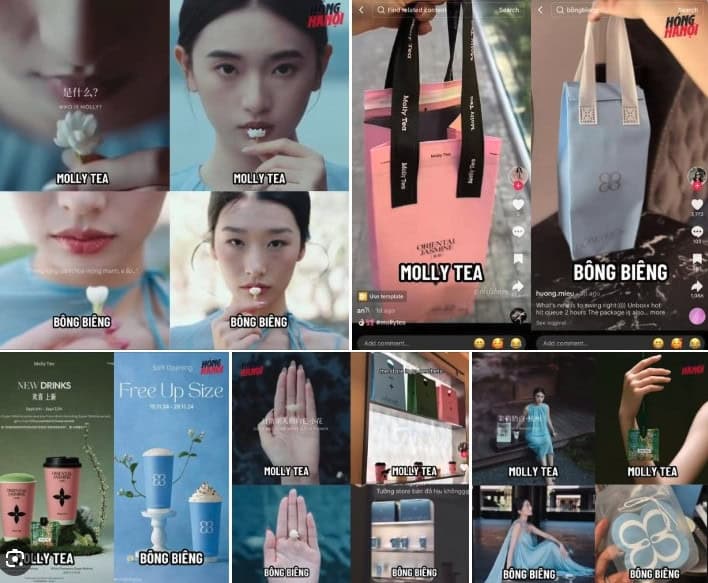
Within weeks of launch, a post in a large Vietnamese marketing group on Facebook set out the similarities with Molly Tea: a pastel palette, a four-petal flower motif, recycled-paper bags tied with ribbon and a promotional video that looked very close to one Molly Tea had posted a year earlier. Commentators put the overlap at 80 to 90%. The brand denied copying and said its identity came from its own research into Vietnamese consumers.
Let’s just say, the similarities are striking…
The business behind it.
Two names come up. Nguyễn Thị Thái Ly is the public face: described as founder and brand ambassador, she answered the copying accusations and says the brand was developed for about 18 months before launch. Company records add the other half. Black Pearl Việt Nam, the company behind the chain, was registered in Hai Phong in May 2025 with Đàm Hoàng Việt as near-sole shareholder, legal representative and director, and its charter capital rose from VND 2 billion to VND 5 billion within about two weeks. Việt says he failed eight times before building Mr Good Tea in Hai Phong in 2015 and Đô Đô in 2021, so Bông Biêng arrived with an experienced operator behind it.
Growth, deliberately slow.
Each store has its own theme (flower, water, sand, stone and so on), so Việt argues the model cannot simply be copied and pasted. The brand’s website lists nine stores, all in Hanoi. Ho Chi Minh City is planned, with no date given, and there is no sign of overseas expansion yet.
Bông Biêng competes in a home market where Chagee, Molly Tea and Mixue are all expanding, and where Chinese brands can face a sharp backlash. Chagee’s Vietnam launch drew boycott calls after a map showing China’s nine-dash line appeared in its app, as I described in The rise of Chagee: how a premium tea brand became a global contender. Bông Biêng’s sharp positioning has won customers. Its weakest point is distinctiveness: if it ever wants to travel, a brand identity that the market already compares to a Chinese competitor will be hard to protect.
Asian bubble tea brands international expansion: the control question
Across all these brands, the issue that decides how far they travel is control: of the name, the product and the partners. Molly Tea, the brand at the middle of our chain, shows what happens when all three slip at once.
The name.
Molly Tea was founded in Shenzhen in 2021 and passed 2,500 stores worldwide by June 2026, including outlets in the US, Canada and the UK. In 2024 it applied to register its four-petal flower as a trade mark. China’s IP office rejected most of the applications because of Louis Vuitton’s earlier registrations BUT Molly Tea kept using the flower anyway.
Louis Vuitton sued in May 2025, naming the parent company and a franchised store in Suzhou. In a first-instance judgment published on 2 July 2026, the Suzhou Intermediate People’s Court found that the flower infringed seven LV trade marks. Molly Tea was ordered to stop using it, pay RMB 10 million in damages plus RMB 300,000 in costs, and publish statements on its website, Weibo, WeChat and mini-programme. The franchisee was made jointly liable for up to RMB 100,000. Molly Tea’s founder says the company will appeal, and the logo has already been redesigned.
Chinese consumers largely sided with Molly Tea. Coverage of the verdict passed 400 million views on Weibo, with netizens pointing to four-petal patterns in Tang dynasty art and Suzhou garden windows, and People’s Daily reported that stores were busier after the ruling. Public sympathy is welcome for the brand, but it doesn’t change the judgment. As Hong Kong lawyer Joshua Chu put it: “You do not build a brand identity first and conduct IP clearance second.” (I would add, there’s even less excuse when the design element is as well known as the LV flower)
Louis Vuitton, for its part, won in court but arguably lost the public argument. That holds a lesson for any European brand enforcing its rights in Asia: a case against a popular local company can trigger a massive nationalist backlash, even when the law is clearly on your side. Enforce your rights, but think about how the case will look to local consumers before you file, and ask a local partner or adviser to judge the mood. Chagee learned a similar lesson in Vietnam, where a map in its app turned a market launch into a boycott.
The partners.
Weeks before the LV ruling, Molly Tea’s Shenzhen headquarters sued its own US partners in federal court in New York. It alleges they set up a new company without headquarters equity, signed an unauthorised lease for a store near Columbia University, swapped ingredients and changed operating procedures, before ignoring months of written warnings. So the same brand is being sued for infringement in China while suing its partners for damaging its trade mark in America. (I told you it was like a soap opera plot)
If you set the four brands side by side, the pattern becomes clear:
| Brand | Expansion model | How it holds control | Where control slipped |
|---|---|---|---|
| Gong Cha | Master franchising, moving to direct franchising | Buying back master franchise territories; proprietary dispensing kit | Left mainland China in 2024 after trade mark disputes and copycats |
| HeyTea | Owned stores, franchising since 2022 | Own warehousing and logistics abroad; flagship Lab stores | Had to rename from Royal Tea to escape trade mark conflicts |
| Molly Tea | Rapid franchising | Litigation after problems arise | Lost to LV at first instance; dispute with US partners |
| Bông Biêng | Owned stores until now, Hanoi only | Store-by-store concepts; automated brewing | Identity widely compared to Molly Tea – likely to limit any future international expansion plans |
Asian bubble tea brands international expansion: five lessons for exporters
None of this is unique to tea. These are the same issues I see European food and beverage manufacturers face when they enter Asia, only played out faster and in a public setting.
- Register before you sell, and before you talk to partners. File your word mark, your logo and local-script versions (Chinese characters, Korean, Thai) in every target market, ideally at least 6-12 months before any planned launch. China is only the start: Vietnam, Indonesia and Thailand are first-to-file, and so are Japan, Korea and Taiwan, so whoever registers first usually wins. Squatters watch for foreign brands that have not yet filed locally, and then effectively hold the brand to ransom. Your EU trade mark gives no protection in a third country until you register there too. Gong Cha lost mainland China to trade mark disputes, and HeyTea had to rename itself. The European Commission’s South-East Asia IP SME Helpdesk gives EU SMEs free, confidential first-line advice and is a sensible first call. That’s not to say that you can’t regain control of your own brand, but avoiding the situation in the first place saves time, money and above all nerves.
- Clear your own identity before you launch it. A freedom-to-operate search costs a fraction of a lawsuit. If your design borrows from fashion or luxury, check it in every market where those houses hold registrations. Molly Tea’s rejected applications were a warning it chose to ignore & they are now paying the price.
- Write the exit into your partner contract on day one. A master franchisee or exclusive distributor buys you speed, but you pay later if you cannot take the market back. Build in performance targets, step-in rights and a buy-back mechanism with an agreed valuation method. Keep every trade mark registration in your own name: the classic food and drink version of this problem is a distributor that registers your brand “to help with import registration”, and you only find out when you try to change partner. If a local partner really must hold a registration, put a watertight proxy agreement in place that obliges it to transfer the mark back when the partnership ends or sign the proxy agreement with a reputable lawyer’s office who office this as a service. Gong Cha’s purchase of 170 US stores shows the price of recovering a territory, and its history shows a franchisee can even end up owning the brand.
- Control what goes into the product. Recipe consistency is also a form of brand protection. HeyTea built its own logistics overseas; Molly Tea is now in court over substituted ingredients. In a distribution agreement, that means approved suppliers, audit rights, control of labelling and a clear process for corrective action.
- Localise the experience, and keep the core fixed. HeyTea’s Bangkok Lab adapts design and menu, Gong Cha adds drive-thrus and food in the Americas, and Bông Biêng gives every store its own theme. The recipe standards and brand assets stay the same. Make sure you decide early on which parts of your offer are negotiable by market, and put the rest in writing.
Control gets more expensive the longer you wait
This story started with a flower. Bông Biêng’s four petals were compared to Molly Tea’s, and Molly Tea’s four petals have now cost it RMB 10.3 million in a case brought by Louis Vuitton. LV in turn has been judged and found lacking by the Chinese public, which can be damaging for the brand even if legally they were proven right.
Look at what each brand paid for control, and when. HeyTea dropped the Royal Tea name while it was still a regional chain, when changing cost them relatively little. Gong Cha let master franchisees build its biggest markets, then paid to buy 170 US stores back, and lost mainland China altogether. Molly Tea skipped the clearance it had been warned about and is now paying with cash, a rebrand and a lawsuit against its own partners. Each time, control of the name, the product and the partners was cheapest at the start, and its price rose with every store opened.
For a European food or beverage brand, the decisions that feel premature on day one are the cheapest you will ever make: registering in markets you haven’t entered yet, and writing a buy-back clause into your first distribution agreement. So the next time a story about “Asian bubble tea brands international expansion” lands in your feed, read it for what it tells you about control: who owns the trade mark, who controls the ingredients, and what happens if the partner underperforms.
Which control decision did you put off in your last market entry, and what did it cost you to fix later?
Thinking that working with a consultant would accelerate your international expansion?
If you’d like to learn more about working with me for support on your internationalisation projects or personal export knowledge, you can book a 30 minute international clarity call here.
If you haven’t already signed up for my free e-book about how to select which international market to enter next, you can do so here, or using the form below.
If you enjoyed this content please share it on social media or recommend it to your network.
Pin this post for later!

Kathryn firmly believes that business is done between people, and therefore places her focus on building strong relationships that form a solid foundation for doing business.
When she's not travelling around the world, Kathryn enjoys playing clarinet in her town's wind orchestra or sharing her love of the outdoors with her Scout group.